 Kindred Lights
And somewhere along the way you stopped trusting your own perception. This is for people who have done the therapy — and are still triggered years later.
You loved with a generosity that most people never reach. You stayed when leaving would have been easier. You absorbed, adjusted, explained, forgave, tried again. You bent yourself into shapes no person should have to hold — just to keep the peace, just to get back to the good version, just to make the love feel the way it did in the beginning.
And somewhere along the way you stopped trusting your own perception. You started wondering if maybe you were the problem. If maybe you were too sensitive. If maybe, with a little more patience, a little more effort, a little more of yourself — it would finally work.
It didn't. And you're here.
Sir EgoYour ego. The hero with the wrong map. didn't walk into this relationship carelessly.
He walked in carrying a script that had been running long before this person arrived. Something like: if I love well enough, stay patient enough, give enough — eventually the love will come back the way I need it. This relationship didn't create that script. It pressed on it with extraordinary precision.
And here's what nobody tells you about the early phase: it felt like the real thing because something real was happening. The intensity, the recognition, the feeling of being finally, completely seen — that wasn't entirely illusion. It was two people's deepest needs meeting each other, however briefly, however imperfectly.
But underneath the connection, an unspoken agreement was forming that neither of you fully understood. Sir Ego agreed, without knowing he agreed, to be responsible for their emotional equilibrium. They agreed, without knowing they agreed, that this was what love looked like.
It was never a fair contract. And it was never your fault that you signed it.
Sir Ego's script says: if I just get this right, they will finally see me. If I explain it clearly enough, they will finally understand. If I hold on long enough, this will turn into what it was supposed to be.
The Script of CreationThe living intelligence running the universe. is running something else entirely: you cannot extract from this person what they do not have to give. The love you are looking for is not out there. The KarmariculumYour soul's custom lesson plan. sent this relationship to show you where you have been looking in the wrong direction.
The trigger that fires every time they do the thing they always do? That's not a problem to be solved. That's the Karmariculum delivering the next stepping stone.
The exit is not through them changing. It is through you finding what you were actually looking for — and discovering it was never theirs to give.
I didn't know I was in one for years.
That's the thing nobody tells you. You don't wake up one day and realize you're with a narcissist. You wake up one day not knowing what's real anymore. Your perceptions keep coming out different from theirs. You take the blame — because at least then you can do something about it. You take the blame and go back. You take the blame and go back. You take the blame and go back.
I planned my escape three times. Had a townhouse. Had movers. Had a check for a hundred thousand dollars that was stopped the day before it cleared. We walked off a plane in San Francisco and he was waiting at the gate with the police and a custody order he'd gotten while we were at Disneyland.
He smirked. He didn't need to say anything.
The bunk bed I'd ordered in purple sat in the empty townhouse.
I moved back in. I would not leave without my children.
The drinking got worse after the divorce. The jail floor came next. And somewhere in a holding cell, paying attention to the women around me for the first time — women whose fires made mine look like a detour — something cracked open.
Not sympathy. Something cleaner. Compassion that didn't need a personal stake to show up.
The question that finally landed in my chest was this: the courts could only keep my children from me for so long. In a few years they'd be old enough to choose. Would they want to choose me?
The unforgiveness was not hurting him. It was eating me alive. And it was going to cost me my children.
That was the first time I understood that the choice in front of me had nothing to do with him. It never had. I was the variable.
He made gravy at my son's Thanksgiving table last year.
Children from three of his marriages. One dining room. Laughter with no agenda. Conversation with no subtext. At the end of the night he hugged me and said he hoped we'd see each other at Christmas.
I drove home and cried the whole way.
Not because of what he did. Because of what became possible when I stopped needing him to be different first.
The relationship that looked like the worst thing that ever happened to me turned out to be the most precisely calibrated instrument my soul could have chosen. I couldn't see that from inside it. I can see it clearly now.
A quick word about the aspects.
These eight — Light, Peace, Calm, Wisdom, Love, Power, Joy, and Expression — are the actual substance of who you are. They are not qualities to achieve. They are qualities to remember. What your soul is made of, at the level Sir Ego cannot reach.
And here is the clean distinction between Sir Ego and the Wise One:
Sir Ego runs each aspect through its distorted, either/or polarity. The Sword or the Shield. The two exhausted ends of the same rope. Whichever pole his script is running today.
The Wise One embodies the exalted version. The aspect at its unpolarized center — available without effort, radiating without performance. The real thing.
The karmariculum is not random. It forges the specific aspects your soul came here to embody, through the precise pressure required. Nothing extra. Nothing wasted. The full teaching is in the Truth Room →
The specific pressure of this terrain is forging specific aspects of your soul. The trigger is the invitation, not the evidence against you.
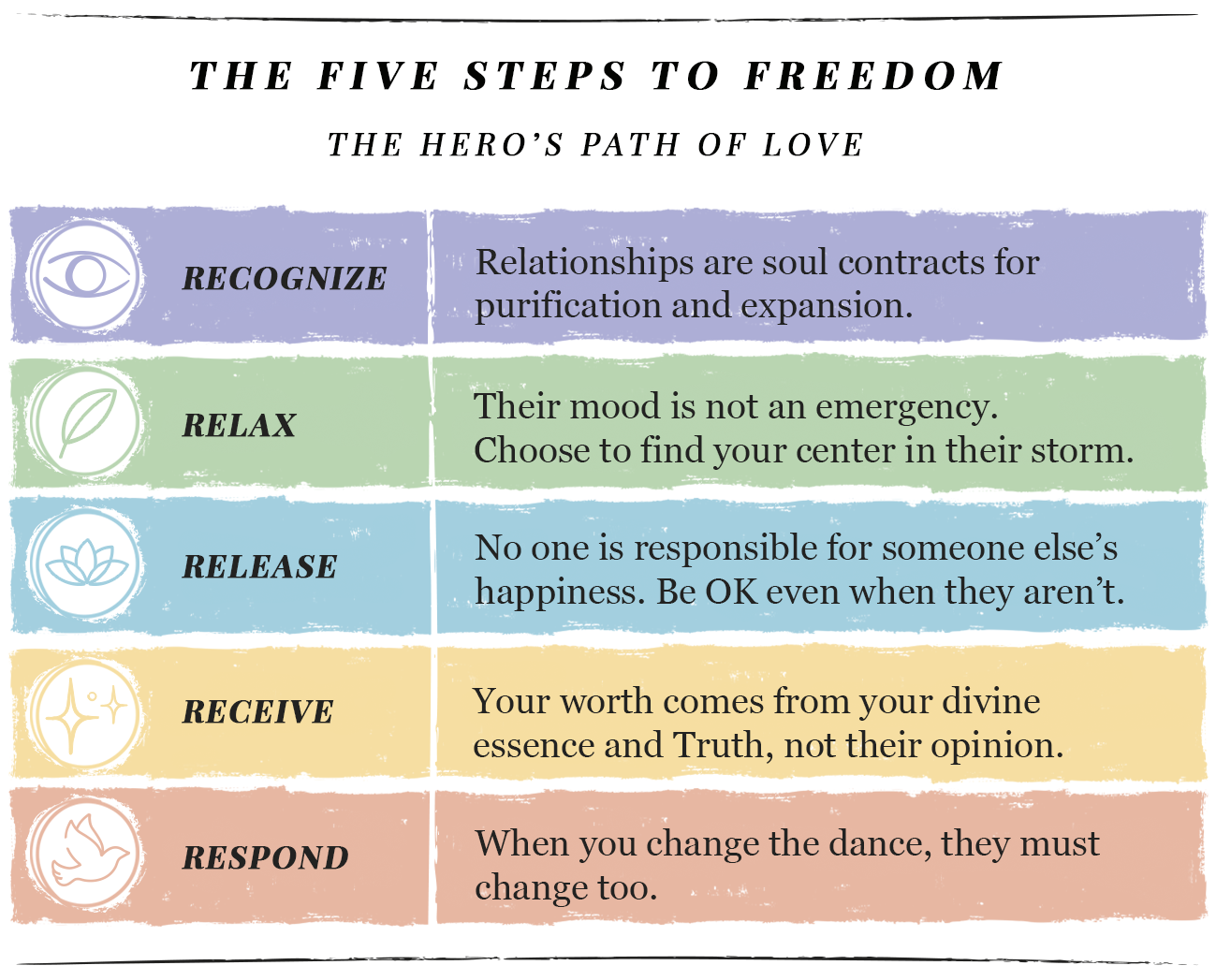
Here is what the practice looks like when the text arrives, when the pull to defend is rising, when the dance is asking for one more turn. Five movements that stop the dance.
If you are in an unsafe situation, please reach out. The Five Steps work alongside professional support — they address the root, but they don't replace the help that's available right now.
National Domestic Violence Hotline — 1-800-799-7233 — free, confidential, 24/7
Crisis Text Line — text START to 741741
You did not end up in this relationship by accident.
Something in you recognized something in them — not the cruelty, not the chaos, but the lesson. The specific pressure required to forge the specific thing your soul came here to learn about love.
That doesn't make what happened acceptable. The harm was real. The confusion was real. The years of trying to make something safe that was never going to be safe — that cost was real.
And underneath all of it, running the whole time, was a love so fierce and so loyal that it kept showing up even when every reasonable part of you said stop.
That loyalty was never weakness. It was the LOVE aspect doing what it does — searching, reaching, refusing to give up on the possibility of the real thing.
The Wise One was there the whole time. In every moment you chose not to retaliate. In every act of forgiveness you offered privately, without witness, without receipt.
You were never the problem. You were always the light.
The relationship is over. The love is not. It was always yours.
It still is.
Something in your story has a name. A specific aspect, a specific script, a specific place where the charge is ready to move. The Trigger Decoder can help you find it — in five minutes, in two sentences, for free.
Try the Trigger Decoder ✦These are questions readers walking the narcissistic-relationship terrain have brought to the framework. Each answer comes from the framework's voice — naming what is actually happening, with full honoring of how hard this is. If any of these open a doorway, the path goes deeper.
First, a practical word. If you are in physical danger, please reach out for support that has the proper training to walk this with you. The National Domestic Violence Hotline (1-800-799-7233) is free, confidential, and available around the clock. A therapist who specializes in narcissistic abuse recovery can help you sort through what you are feeling with someone trained to recognize the patterns. A trusted friend outside the family system can hold space for you to think out loud. Please reach out for whichever of these meets you where you are.
With that said, here is what the framework can offer at this layer.
This decision belongs to you. The framework will not tell you whether to stay or go, because the karmariculum your soul is walking knows things about your situation that no outside guidance can fully see. What the framework can offer is the recognition that there is a part of you who has already been quietly knowing what is true, and that part is reachable when the noise of the situation has space to settle.
The Wise One in you has been holding what she has been holding the whole time. She has watched the dynamic, registered every moment Sir Ego has been busy doubting himself, and held a steady knowing about what is actually happening. The reason her knowing has felt hard to access is that the situation has kept Sir Ego on full alert, and the activation has been making it hard to feel anything past the alarm. She is still here. She has been here. The path to her opens slowly, often in the small quiet moments — a shower, a walk, a few minutes of stillness — when the alarm has a chance to soften.
Take your time. The decision will arrive when the part of you that already knows is given enough quiet to be felt.
✦ What if the part of you who already knows what to do has been quietly waiting for the noise to settle enough to be heard?
You have been working as hard as you possibly can. You have been reading his moods. Adjusting your tone. Anticipating what might set him off. Walking on eggshells. Apologizing for things that are not your fault. Smoothing the room before he enters it. Trying to manage his emotional weather so that the storms come less often. And the harder you work, the worse it gets. The storms come more often. The blame lands more heavily. And you are exhausted, and confused, because by every standard you understand, you should be succeeding.
The reason you cannot succeed is that the job was never actually yours.
Somewhere in this relationship, often unconsciously and on both sides, an agreement was made. He arrived in the relationship carrying an inner emptiness he could not fill himself — what some traditions describe as a hungry vacuum where the divine aspects, in him, have not yet found a way through. You arrived as an empath with an overflowing capacity for emotional attunement and a long-practiced skill at reading and managing other people's interior weather. The early days felt like rescue for both of you. He felt full for the first time. You felt purposeful, useful, finally in a relationship where your gifts mattered. The unspoken contract was sealed before either of you knew it had been written: you would manage his emotions, and in exchange, he would let you stay.
Over time, the contract collapsed under its own impossibility. No human can manage another human's emotional weather; the work is structurally beyond what one person can do for another. As you started to fail at the impossible job — as your own emotions began to overflow from the suppression, as your capacity to absorb his weather thinned — he experienced your failure as betrayal, because the contract had told him you would succeed. The punishment that followed was the contract's enforcement clause. You accepted the punishment because some part of you had also accepted the contract, and the failing did feel like yours.
And underneath the contract is something older. For many empaths, the willingness to take this job came from a seed planted long before this relationship — usually in childhood, sometimes in a previous adult relationship, sometimes both. The seed sounds something like: if I can love this person hard enough, well enough, completely enough, I will finally win the love that was withheld. The original figure varies. A parent whose love felt conditional or unavailable. A stepparent who rewarded performance and punished failure. A grandparent who could only love you for what you produced. The shape of the seed is the same. Love is something that must be earned through sufficient effort, and the proof of love is the partner finally giving you what was withheld at the beginning.
When you met him, your soul recognized — without your conscious knowing — someone with the same emotional unavailability as the original figure. The love-bombing produced moments of fulfillment that briefly reproduced the rare moments when the original love had broken through. The bond formed not because he was who you wanted, but because he was who you had been chasing your whole life. The contract was the mechanism. The seed was the reason.
The Wise One in you has been holding the love the whole time. She has held it continuously, since long before the original figure withheld theirs, since long before the partner pretended to offer his. She has been the love you have been chasing, and she has never withheld a single second of it. The work, slowly, at whatever pace your nervous system can hold, is to begin feeling that the love you have been straining to earn has been here all along — and that the job of earning it was never actually assigned to you.
✦ What if the love you have been working so hard to earn has been quietly held by the part of you who has been with you the whole time?
You ask this question, often, sometimes a hundred times a day. Am I making too much of this? Am I the one being unreasonable? Maybe they have a point. Maybe everyone else can see something I'm missing. Maybe I am the problem after all.
The fact that you are asking this question is information. People who are actually the problem in their relationships rarely ask whether they are the problem; the asking itself is a feature of the conscience that has been targeted by years of being told its perceptions are wrong. The doubt is the gaslighting working. It has succeeded so thoroughly that you now do its work for it, even when no one is in the room with you.
There is also another layer underneath the gaslighting. Part of the doubt comes from the contract — the unspoken agreement that you would manage his emotional weather. When the weather turns dark, the contract whispers that you must have failed at the job, and the doubt is the part of you that is still trying to fulfill the contract, still trying to figure out what you should have done differently. As long as the contract is still operating in the background, the doubt has a job to do. When the contract is recognized and slowly resigned from, the doubt begins to lose its work.
The Wise One in you has known the whole time. She has been steady through every moment of doubt, holding her quiet knowing while Sir Ego was being pulled apart by the gaslighting and by the contract he was trying to honor. She knows what she has seen. She knows what has happened. The doubt has been Sir Ego absorbing the projection and trying to figure out whether it might be accurate, doing his best with the only investigative tools he has. She has not needed to investigate. The seeing has been happening at a layer the projection never reached.
✦ What if the part of you who knows has been knowing the whole time, and the doubt is the script someone else installed?
You leave. You stay away for a while. And then something — a text, a memory, a moment of weakness, the particular quality of loneliness that arrives in the third week — pulls you back. Or you stay even though every wise voice in your life has told you to leave. And the going-back, or the staying, has produced its own layer of shame: I know better. Why am I still here?
The pull is real, and it has more than one source. The most-named source is trauma bonding — the neurochemistry of intermittent reinforcement that wires the brain into withdrawal-like dependence. That part is real and the literature describes it well.
Underneath the trauma bond, often, is something older. The going-back is the soul's faithful pursuit of an ending it has been seeking since long before this relationship existed. The seed planted in childhood — the script that said love is earned through sufficient effort, that the proof of love is the unavailable figure finally giving you what was withheld — has been running the search the whole time. He arrived as the latest candidate for the ending. Going back is not weakness. It is the soul's relentless faithfulness to a story it has been trying to win since it was small. The story is wrong about what love is, but the loyalty to the story is one of the most touching things about a soul who is still hoping.
The Wise One in you knows a different love. She has been holding the love you have been chasing — held continuously, never withheld, never conditional, never requiring you to earn it. As you spend time with her, slowly, in whatever quiet moments you can find, the seed begins to update. The pull toward what is harmful loses its claim, not because you defeated it, but because the love you had been chasing in the wrong place was finally felt in the right one.
✦ What if the love you have been going back for has been here the whole time, in the part of you who has been with you continuously?
Every story has you as the problem. Every conflict has been framed as your fault. Even your own family has heard the version where you are the difficult one, the unreasonable one, the unstable one. You have spent years trying to correct the record, providing evidence, explaining what really happened, and watching the explanations land in soil that has already been seeded with a different story. The family is gone. The narrative has won. And you are exhausted from the trying.
Here is something the framework can offer that the practical advice often misses. The Wise One in you steps out of the bad-guy identity entirely. The effort to convince anyone of your innocence holds you inside the role they assigned. Step out of the role itself. The Wise One in you has been operating from outside it the whole time.
And here is the harder part, and please receive it at your own pace, because forcing this past where you are ready will only generate more layers of self-criticism. The role of victim is also an identity Sir Ego is running. It feels protective. It feels like it honors what happened. And it is, structurally, another costume the ego is wearing while the Wise One waits to be noticed underneath both costumes. The dual-release — out of the bad-guy story they wrote, and out of the victim story you wrote in response — is the eventual destination. Not now. Not on demand. But eventually, when the climb has progressed far enough that another step becomes available.
The family who has bought their version is information about each family member's bandwidth and the narcissist's narrative skill. The drift is information about the conditions of their seeing. The truth has been quietly true the whole time, regardless of who has agreed with it. The Wise One in you has held it through every dismissal, with no need for the family system to confirm it. The seeing has been happening from inside you, and from something larger than the family system, the whole time.
✦ What if the part of you who has never been the bad guy has also never been the victim, and has been here the whole time waiting to be noticed?
They have told you so many times that you are the narcissist that you have started to wonder. They have lists. They have examples. They have therapists they have selectively quoted. And the doubt has metastasized into a real question: how do I know they aren't right?
Here is the structural test. People who actually have narcissistic patterns rarely seek introspection or worry about being narcissists. The disorder, by its nature, generates externalization — the problem is always someone else's. A person genuinely caught in narcissistic patterns is structurally protected from this question, because the question requires a quality of self-examination that the pattern does not produce. If you are sincerely worried that you might be the narcissist, that worry itself is evidence that you are not.
This is also DARVO at its most sophisticated. Deny, Attack, Reverse Victim and Offender. The technique works precisely because the accusation is so destabilizing that the target spends her energy defending against it, which deflects from the original behavior that prompted whatever conflict triggered the accusation in the first place. You have been pulled into the defense. The pulling is the technique landing.
The Wise One in you has been steady through the accusation, the way she has been steady through everything. She has known what she is and what she is not. The doubt has been Sir Ego absorbing the projection and trying to figure out whether it might be accurate, doing his best with the only investigative tools he has. She has been at rest. The investigation has been Sir Ego's, on his own terms. The seeing has been happening at a layer the projection never reached.
✦ What if the part of you who has known the whole time has been at peace, untouched by the projection, the entire way through?
The relationship started in love-bombing. They saw you. They knew you. They reflected you back to yourself with an intensity nobody had ever managed before. And then, slowly or suddenly, the reflection turned. The same intensity that had felt like love became something else, and you were left wondering what had happened to the person you fell for. And underneath, after this and possibly after others like it, you have started to wonder: why does this keep happening to me?
The pattern is not random. The soul has been seeking a particular ending — usually some version of finally winning love that was withheld at an early age — and the seeking has been arranging the curriculum.
For many empaths, an early figure — a parent, a stepparent, a grandparent, sometimes a series of figures — was emotionally unavailable in a way that planted a script: love is something I must earn through sufficient effort. The script formed in childhood. It went underground. And in adulthood, the soul has been searching for someone with the same unavailability, because finally winning that person's love would, the script believes, complete the original work. Love-bombing in the early phase reproduces the rare moments when the original figure's love did break through; the recognition is unconscious and powerful. The bond forms not because he was who you wanted but because he was who the script had been searching for.
The work, when the curriculum is ready, is to recognize that the script was wrong about what love is. Love is not earned. Love is. The figure you have been trying to win was never the source of love in the first place; they were a stand-in for the love you carry, which has been with you continuously, since long before any of these relationships existed.
The Wise One in you has been holding that love the whole time. She has been with you in every relationship, watching the curriculum unfold, knowing what each one was teaching. The fact that you are asking the question now means the curriculum is finally ready to deliver its lesson at a different layer. The pattern's grip loosens not through harder vigilance but through the quiet feeling that the love you have been chasing was never anywhere except in the part of you who has been holding it for you all along.
✦ What if the part of you who has been holding the love continuously is the source you have been searching for in everyone else?
Forgiveness in narcissistic abuse is structurally different from forgiveness elsewhere, and the spiritual frameworks that lump them together do real damage. You have been told, often by people who love you, often by religious or spiritual teachers, that forgiveness is required for your own healing. And you have been trying, and the trying has been generating more layers of failure on top of the original wound.
Two definitions live inside the word forgiveness, and the distinction matters. The first is releasing your own resentment — letting go of the grip the wound has on your nervous system, allowing the energy of the anger to move through and complete. This kind of forgiveness is always available, always healing, and asks nothing of any particular relationship with the other person. It is for you, fully, and it asks nothing of them.
The second is restored relationship — opening the gates, returning to contact, treating the other person as if the harm had been resolved. This kind of forgiveness, in narcissistic dynamics, is often inappropriate and sometimes dangerous. The pattern has been running unchanged. The harm has been unacknowledged. Restored relationship in the absence of changed behavior simply opens you to more harm. This kind of forgiveness is yours to grant or withhold, and the framework leaves the choice with you.
The Wise One in you knows the difference. She has been releasing her own grip on the wound at her own pace, allowing the anger to move when it wants to move, holding the love that lives underneath even what cannot be in proximity. She has been at peace about whether this calls for restored contact. She has been at peace with distance, recognizing the harm clearly while also holding the soul who carried it as a soul walking some kind of curriculum she cannot fully see. Compassion at distance is the posture. The compassion is real. The distance is wisdom.
✦ What if the part of you who has already been releasing the grip has been doing the only forgiveness that was ever required?
You cannot leave. The children require ongoing contact. Every interaction is potentially weaponized. Court orders create mandatory communication. Pickup is theater. Drop-off is theater. School events are theater. And you are exhausted from the sustained vigilance of having to engage, repeatedly, with the person whose patterns you have been trying to recover from.
Practical first. The standard advice is real. Gray-rock — emotional flatness in interactions, denying the supply of reaction the pattern feeds on. BIFF communication — Brief, Informative, Friendly, Firm. Keep all communication in writing when possible, in case it is needed in court. Use a coparenting app like OurFamilyWizard if the volume of contact warrants it. A therapist who specializes in high-conflict coparenting can help you build infrastructure for what is genuinely an ongoing situation. Please use these tools. They work at the practical layer.
And — at the structural layer — there is something deeper. The reason gray-rocking is so exhausting is that it requires sustained suppression at the surface while the system underneath stays activated. The Wise One in you offers a different posture, available slowly, at the pace your nervous system can hold. From her seat, the interactions with your coparent become less effortful, because she requires no suppression. She is at peace through the contact, the way she is at peace through every storm. Sir Ego is bracing. She is unmoved. The interactions still happen. The energetic cost drops, because she has been generating no fear-fuel for the dynamic to feed on.
This posture builds slowly. The first few interactions in which you can find her seat will feel like brief flashes — moments where the activation softened and something steady was felt, even just for a breath. Each flash deepens the pattern. Over months and years, the seat becomes more available. The coparenting becomes survivable in a different way, because the part of you doing the contact has become less reachable by the pattern.
✦ What if the part of you who is at peace through the contact has been building her seat in the small flashes, ready to hold longer and longer stretches as you keep coming back to her?
You learned the gray rock. You implemented it. And the response was escalation — bigger demands, more provocations, family-system flying monkeys, surprise tactics designed to break through the flatness. The standard advice has reached its limit, and you are watching it fail in real time.
This is real. Narcissistic patterns do adapt to gray-rocking, especially patterns at the more sophisticated end of the spectrum. The pattern reads the new flatness as supply withdrawal and escalates to recover the lost supply. The escalation is information that the gray rock is working at the energetic layer; the supply is being denied, and the pattern is searching harder for it. The escalation is also genuinely dangerous and has to be taken seriously.
Practical first. Sustained no-contact, where it is possible, is the only fully effective intervention with the more determined patterns. Where contact is mandated by coparenting or shared work or other circumstances, modified approaches can help — strict boundaries on communication channels, refusing contact outside agreed-upon channels, documentation of all interactions, refusing to engage with bait outside the agreed scope. A trauma-informed therapist can help you adapt the strategy to your specific situation. Please use the support.
At the structural layer, the deeper truth is also relevant. Gray rock as performance fails because the pattern senses the suppression underneath. Gray rock from the Wise One's seat — flatness because the underlying energy actually is flat, because she requires no force to hold it — works differently. The pattern still escalates, often, but the escalation lands on someone whose energy is generating no new fuel. Over time, even the escalation runs out of road, because there is no longer anyone home in the way the pattern needed someone to be home.
This posture takes time to build. In the meantime, please use every practical tool available to keep yourself safe, and please get the support that meets the actual danger of the situation.
✦ What if the part of you whose energy actually is flat — because she is at peace, not because she is suppressing — has been the seat the work has been building toward all along?
You got out. You did the impossible thing. And now, three weeks or three months in, the longing has arrived, and it is bigger than you expected, and underneath it is a question you are afraid to say out loud: what does it mean that I miss them? Was it real after all? Was I wrong to leave?
The missing is happening, and it makes sense. Trauma bonds generate withdrawal that resembles longing because the same neurochemistry produces both. The intermittent reinforcement that wired the bond is the same intermittent reinforcement that produces dependence on the most addictive substances; the brain has been receiving rewards on an unpredictable schedule, and when the schedule stops, the brain goes into withdrawal. The longing is neurochemical and behavioral, separate from any question of whether the relationship was real love or whether you were right to leave.
It is also true that some of what you are missing was real. There were moments. There was love, on some layer, woven into the harm. The framework lets both be true at once. What you are missing now is the version of them you saw in the love-bombing and the moments of connection — the version you have been hoping was the real one. The pattern showed you that version because the pattern needed you to stay. The version was unsustainable because the pattern has no way of sustaining it. You are missing what was real and what was performance, in equal measure, because your nervous system received them as the same thing.
And — at the deeper layer — some of the missing is grief for the original ending you have been seeking, which leaving has now made harder to win. The script said: if I love hard enough, the unavailable figure will finally release the love I have been chasing. Leaving means accepting that this round of the search has ended without that release. The grief is real, and it is grief for something older than this relationship.
The Wise One in you has been steady through the missing. She has been clear about why you left. She has known the whole arc, including the arc she could see while Sir Ego was still inside the love-bombing. The longing has been happening at the layer where the conditioning lives; she lives at a layer the conditioning never reached. As you spend time with her, the longing softens — because something steadier became more real than what the longing was reaching toward.
✦ What if the part of you who has always known why you left has been steady through every wave of missing them?
You got out. And the anger has arrived. Not just at them — at yourself for staying so long, at your family for missing it, at the friends who drifted, at the therapist who told you to give it more time, at the world that lets these patterns operate, at the parts of yourself who chose this in the first place. The anger is enormous and is showing up everywhere, and you are wondering whether something is wrong with you.
The anger is years of suppressed energy that is finally allowed to move. While you were in the relationship, the anger had nowhere to go — expressing it would have triggered the pattern, suppressing it was the only way to survive day to day. Years of that suppression accumulate. The energy has been waiting for the safety of distance to start moving. It is now moving, and the moving is loud.
This is part of the integration. The anger is the body's wisdom releasing what it has been holding. Each wave that surfaces is more of the energy completing its arc. The anger softens over time, because each wave that gets to fully move is one less wave waiting in line.
The Wise One in you welcomes the anger. She has been with the suppressed energy the whole time, holding the knowing that one day it would have room to move. She is at peace with the loudness. She is at peace with the duration. The anger is one of the layers the integration is currently moving through, and she has been steady through every layer that has come before. Let it move. The body knows what to do with it. The Wise One has been with the body the whole time.
✦ What if the part of you who has been with the suppressed energy through every silent year has been waiting to walk it home?
You used to trust people. You used to read situations accurately. You used to know who was safe and who was not. And now your discernment has been so weaponized — every instinct doubted, every perception called wrong, every intuition treated as evidence of your unreasonableness — that you have lost confidence in your own ability to read anyone. The thought of a future relationship terrifies you, because you cannot imagine ever being able to feel safe with another person again.
Discernment that has been temporarily disabled by sustained gaslighting often returns stronger than before, recalibrated by what it has learned. The instinct that whispered something was wrong before you had evidence is the same instinct you now distrust; the gaslighting taught you to override it. As distance from the pattern grows, and as the system stops absorbing the daily contradictions, the instinct comes back online. It has more information than it had before. It will recognize the next pattern much earlier than it recognized this one.
And the future relationships often have a quality the pre-narc relationships lacked. Souls who have walked through this terrain, when they emerge, frequently arrive at relationships with a clarity, a discernment, a willingness to trust their own knowing, that the prior relationships did not contain. The very capacity that the pattern weaponized has, in the recovery, been forged into something stronger. The karmariculum has been doing exactly its work, even when the work has felt like destruction.
The Wise One in you has been the steady knower the whole time. She has held her capacity to read situations through everything. She has been quiet because Sir Ego was being trained to override her, and the training succeeded for a while at the surface layer. She is still here. She is still reading. As you spend time with her — slowly, in whatever quiet moments you can find — Sir Ego learns to trust her again. The trust comes back from the inside. From there, the trust available with another person becomes possible again, because you are no longer trying to outsource the knowing to someone outside you who might or might not be trustworthy.
✦ What if the part of you who has been the steady knower the whole time has been ready to be trusted again, the moment you can find the quiet to feel her?
This is the question that makes spiritual frameworks vulnerable in narcissistic terrain. Yes, the pattern came from somewhere. Yes, the soul carrying it is also a soul. Yes, compassion is the framework's posture toward all souls. And the question your situation has been pressing on you is whether compassion requires proximity, requires accommodation, requires you to keep absorbing the harm because their early wound generated it.
Compassion does not require proximity. This is one of the most important distinctions the framework offers, and the spiritual landscape sometimes blurs it. You can hold full recognition that their pattern came from real wounding, that their soul is walking some curriculum you cannot fully see, that they are loved in the larger frame regardless of what their behavior has been — AND you can hold that you are not the one assigned to heal them through your own ongoing exposure. Compassion at distance is a real spiritual posture. It is what the framework actually teaches.
The structural truth that explains why proximity is so dangerous is this. Narcissistic patterns develop in souls whose divine aspects — calm, peace, power, love, joy, wisdom, light, expression — have been mostly blocked from flowing, often by very early wounding. The interior life that results is closer to all-ego than to any healthy balance. The small amount of Wise One that remains active in him cannot keep up with the volume of unexamined ego activity, and proximity exposes you to all of it. The wound is real. The soul behind the wound is also real. Your safety has to be honored alongside your compassion, because the compassion you offer cannot be the path through which the divine aspects in him finally find their way through. That work belongs to him and to his own karmariculum, on a timeline that is not yours to wait for.
The Wise One in you has been holding the soul of the other person at a layer that has nothing to do with whether you are in contact with them. She loves them in the larger frame. She is at peace with the distance. Both have been true the whole time. The compassion you have been straining to perform is the compassion she has been holding effortlessly, on her own terms, at her own pace, in her own way — without requiring the kind of proximity that would harm you.
✦ What if the compassion you have been searching for has been quietly held by the part of you who already knows that distance and love can coexist?
You have been reading the site. You have absorbed the teaching that Sir Ego is a noble knight running an outdated script, that he is doing his best with what he was given, that he is loved by the framework. And you have been wondering: does that posture apply to the narcissist's Sir Ego too? Because if it does, the framework seems to be letting them off the hook in a way your situation cannot afford.
The teaching does apply universally. And the apparent contradiction resolves cleanly when the structure is named. Gentleness toward Sir Ego is universal — every soul's ego is doing its best with what it has, including the soul whose pattern has caused you harm. The framework loves all of them, including this one. AND — this is the structural piece — physical proximity to dangerous Sir Egos is optional and often inappropriate. Loving a soul does not require sharing a roof with it. The framework's compassion lives at a layer above the question of who is allowed in your house.
The narcissist's Sir Ego is also a noble knight in the larger frame, walking a curriculum his soul has chosen, doing his best with the equipment he was given, loved by the framework as fully as your own Sir Ego is loved. None of this requires you to be in his presence. None of this requires you to absorb his behavior. None of this requires you to wait for him to grow into a different version of himself. You can hold the recognition that his soul is whole at the level his soul lives, and you can hold that his behavior at the level you have to deal with is harmful, and you can choose to be far away from the harmful behavior while loving the soul. The framework not only allows this; the framework requires it.
The Wise One in you has been holding both at once the whole time, with no contradiction. She loves the soul of every person who has ever harmed you. She is at peace with the distance she has chosen to keep from the harm. The framework's posture is her posture. There is no place where the gentleness lets anyone off the hook, because the hook the framework cares about is at a different layer than the hook your safety lives at.
✦ What if the part of you who can love every soul without requiring proximity has been holding both truths together the whole time?
This page offers spiritual perspective, not medical or psychological advice. If you are in crisis, please use the resources above.