 Kindred Lights
You love them more than anything. And something keeps getting in the way. This is for parents who have tried everything — and are ready to look somewhere new.
That's not the question. The love has never been the question. The question is why the love keeps landing wrong — why the conversations that start with care end in shutdown, why the help arrives as pressure, why the child who needs you most keeps pulling away.
You've read the books. Tried the approaches. Adjusted your tone, your timing, your words. And here it is again — the familiar dynamic, a different day.
What nobody tells you is that the trigger isn't really about your child. It's about you. Specifically, about the place in you where their struggle lands — and what it means to you that they're struggling.
That's where the charge lives. And it was there before they were born.
Sir EgoYour ego. The hero with the wrong map.'s parenting script was written in love and executed in fear.
My job is to keep them safe. My job is to fix what's broken. My job is to prevent the pain I can see coming before it arrives. This is not a bad script. It comes from real love — the ferocity of it, the terror of watching someone you would die for struggle.
But underneath the love is a quieter line Sir Ego doesn't always hear himself running: if they are not okay, I am not okay. Their distress becomes his distress. Their pain becomes his emergency. And without meaning to, he places that emergency on the table between them — where they have to live with it every time he walks in the room.
There's another line underneath that one, quieter still: I know I'm a good parent when their sailing is smooth and I've set them up for success. Which means every time they struggle, Sir Ego isn't just worried about them. He's quietly losing points on a scorecard he didn't know he was keeping.
The child doesn't need to be fixed. The child needs a parent who is not frightened by their pain.
Sir Ego's script says: if I find the right approach, the right words, the right specialist, the right intervention — I can engineer their way back to okay.
The Script of CreationThe living intelligence running the universe. is running: this child has their own KarmariculumYour soul's custom lesson plan.. Their own soul contract. Their own relationship with the divine that doesn't need your management. Your job is not to fix the lesson. Your job is to be the open-hearted presence that makes it safe for them to find their own way through.
Every time the fixing instinct fires — that's the collision. Sir Ego reaching for control he was never meant to have. The Script of Creation asking for the trust he hasn't offered yet.
The most powerful thing a parent can do is also the hardest: keep your fear off the table. Stand on solid ground. Keep the heart open. Extend your hand. And trust the intelligence that is already running their life far more precisely than your best plan ever could.
My daughter was disappearing.
A serious illness had pulled this thriving teenager into a darkness I couldn't reach. I'm a fixer. I have an MBA. I could project-manage my way out of anything.
Except this.
Every suggestion I made was delivered with love and received as pressure. Every conversation ended the same way — her retreating further, me standing in the hallway, hating myself for making it worse. The bed was never empty. Abandoned schoolbooks gathered dust.
I kept jumping into the mud puddle with her. I'd get down in the mud, try to pull her out, and we'd both end up covered in it. My fear mixed with her pain. My urgency amplified her despair.
The thing that was supposed to be love became one more thing to survive.
One firm rule started to guide me: fears are for the Wise OneYour higher self. Already home., and love is for the children. Don't mix them up.
I couldn't bring my fear into her room. She could feel it before I opened my mouth. Fear adds to fear. What she needed was someone who could see past the current darkness to the soul who had chosen this curriculum — already whole, already held, exactly where she needed to be.
I started keeping the table between us clean. No fear piling up in the space between us. Door open. No strings. The lighthouse holding steady.
At first it felt artificial. Sir Ego hated it. He wanted to charge in with a plan.
But over time, something shifted. I came to genuinely embody it — unattached presence. Fully there, fully feeling, fully trusting that the soul in front of me had her own journey.
One Mother's Day she handed me a piece of paper.
Fifty-five reasons you are the greatest mom.
She threw it at me and ran out of the room so she wouldn't have to watch me cry.
Not the ones about cooking or concerts. The ones that tell you what she was actually measuring.
You trust me implicitly. You never criticize me. You have complete faith in me. You let me work things out for myself. You love me unconditionally.
Number fifty-five: you love me unconditionally.
The person who had spent years white-knuckling it through every conversation could not have produced those fifty-five reasons. What she was describing was what arrived when I stopped needing her to recover on my timeline.
A quick word about the aspects.
These eight — Light, Peace, Calm, Wisdom, Love, Power, Joy, and Expression — are the actual substance of who you are. They are not qualities to achieve. They are qualities to remember. What your soul is made of, at the level Sir Ego cannot reach.
And here is the clean distinction between Sir Ego and the Wise One:
Sir Ego runs each aspect through its distorted, either/or polarity. The Sword or the Shield. The two exhausted ends of the same rope. Whichever pole his script is running today.
The Wise One embodies the exalted version. The aspect at its unpolarized center — available without effort, radiating without performance. The real thing.
The karmariculum is not random. It forges the specific aspects your soul came here to embody, through the precise pressure required. Nothing extra. Nothing wasted. The full teaching is in the Truth Room →
The specific pressure of parenting is forging specific aspects of your soul. The trigger is the invitation, not the evidence against you. These are the aspects most commonly at work in this terrain.
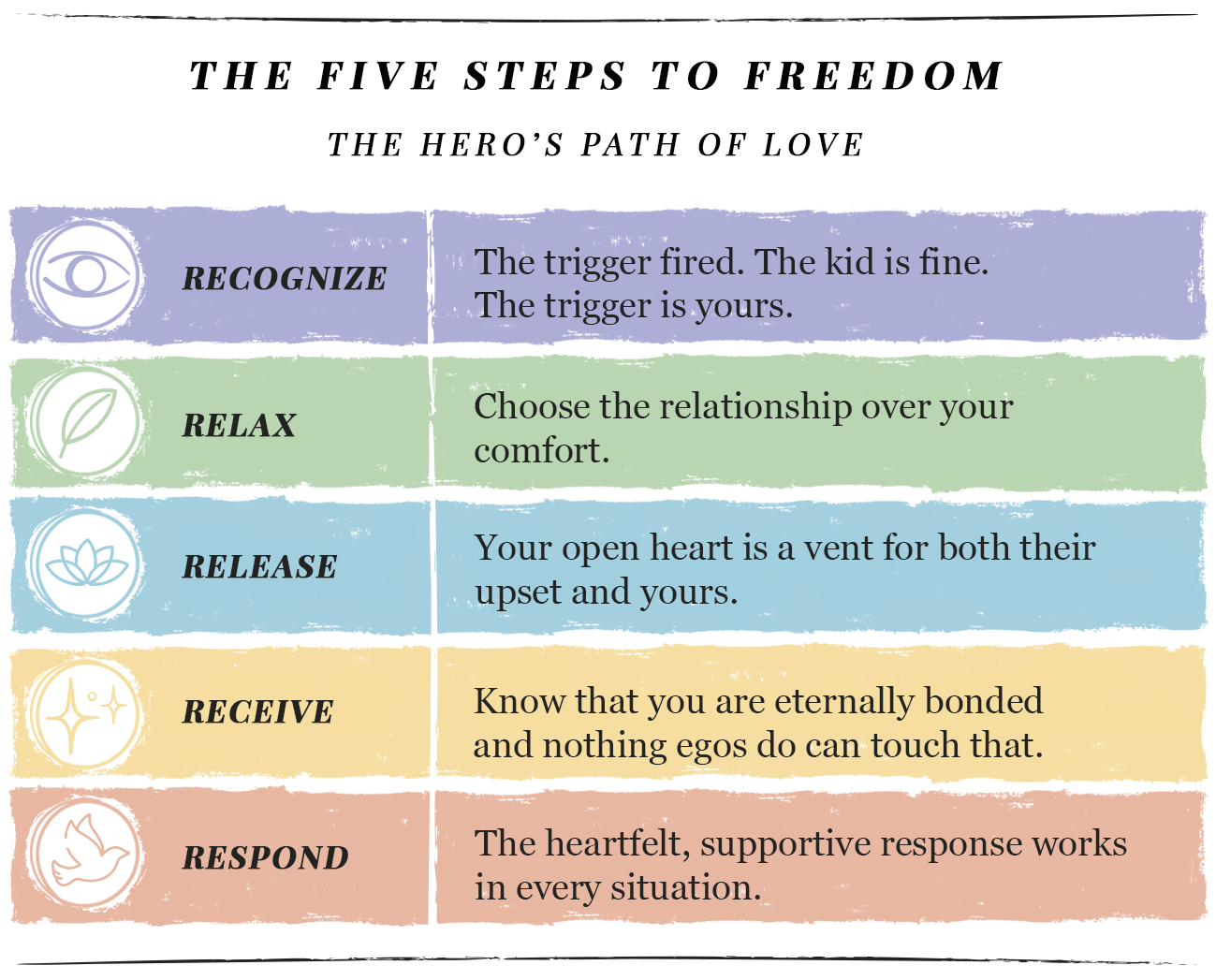
Here is what the practice looks like when your kid's hard moment lands in your chest. Five movements that locate the trigger where it actually lives.
You came here to love a soul you cannot save, fix, or finish. That was never your assignment.
The assignment was this: stay open. Keep the table clean. Bring love through the door and leave the fear at the altar.
Every moment you held steady when everything in you wanted to intervene — that was the work. Every time you kept your fear off the table so they could feel only the love — that was the practice.
Your child chose you. Not because you would be perfect. Because your particular fire would forge exactly what their particular soul came here to learn.
The Wise One in you has always known this. She was the one who stood at the door and kept the heart open when Sir Ego wanted to charge in with a plan.
You are not the savior. You are the sanctuary.
And that is everything.

The Five StepsRecognize. Relax. Release. Receive. Respond. are the practice. Love Heroically is the map that goes with them — written from the mud puddle, not the mountaintop.
It takes you deeper into what you just experienced here: how to recognize the trigger, how to work the steps in real time, and what becomes available when the charge clears and the Wise One takes over.
Not a theory. A practice, forged in the exact fires described on this page.
Learn More →Something in your story has a name. A specific aspect, a specific script, a specific place where the charge is ready to move. The Trigger Decoder can help you find it — in five minutes, in two sentences, for free.
Try the Trigger Decoder ✦These questions arrive often from parents walking the framework alongside the daily work of raising children. Each answer comes from the framework's voice. If any of these open a doorway, the path goes deeper than the answer alone.
Your teenager reaches places in you that no one else can reach. One door slam and you are done. The eye-roll lands harder than your boss's worst feedback. And the hair-trigger quality is real, even though it makes no sense by ordinary standards — coworkers who have known you for years can ask you for things and barely register, while your fifteen-year-old can change your entire afternoon with a single sigh.
This is structural, and there is a reason. Your karmariculum brought you into this life together to work things out. Like polishing pebbles in a tumbler — the two of you came in to provoke each other's unfinished business with a kind of intimacy nobody else has access to. You set up the birth circumstances that they will eventually call "my parents did this to me." And they pay you back when they are teenagers, because they raise your own unresolved material from when you were their age.
Then there is the dance underneath. You have been bonded with them since they were tiny — fully responsible for their safety, their happiness, their protection. You feel their pain as your own. And the unspoken assumption has been that this responsibility continues forever, even though, at some point, they stop being your responsibility. That is the Creator's job. The Creator has no grandchildren.
These triggers operate at unusual depth. They are triggers you have had over and over for a decade or two, and every time the activation has had less than full room to complete, the trigger has grown. By now they are hair-triggers. The people at work have simply had less time to cultivate them.
The Wise One in you has known all this for years. She has been holding both of you — the parent and the child — with the same steady love, watching the curriculum unfold, knowing what each round of activation has been bringing forward. The reactivity you experience is Sir Ego doing his best with hair-trigger equipment. Underneath the reactivity, she has been at peace with the whole arc, including this exact moment.
✦ What if the part of you who has been steady through every door slam has been with you and your child the whole time, holding the whole curriculum?
You know better. You have done the reading. You have been to therapy. You can articulate what is happening when it happens. And then your kid does the thing, and you lose it anyway, and afterward the worst part is that you knew better the whole time. The knowing-better has produced its own layer of shame on top of the original reactivity.
The reading and the therapy and the framework knowledge live at one layer. The trigger lives at another. Sir Ego, who has been studying parenting books, is operating in the part of the brain that does cognitive integration. The trigger is operating in the part of the body that responds before cognition has time to land. The two layers are operating on different timelines. By the time Sir Ego's careful reading reaches the moment, the moment has already happened.
This is the structure of how triggers work. Cognitive understanding alone has limited reach into a trigger that lives in the body. The work that actually loosens the trigger happens at the body's pace, through repeated exposure to the trigger from a slightly different posture each time, until the body learns that the activation has another way to complete. The books and the therapy are useful infrastructure. The actual undoing happens in the moments themselves, gradually, over many returns.
The Wise One in you has been at peace through every losing-it moment. She has been with you and your kid in the kitchen, the car, the doorway, watching Sir Ego do his best with the equipment he has, holding both of you with the same steady recognition that the work is being done at a layer he cannot yet feel. As you spend time with her — in the small quiet moments after a hard interaction, in the breath that lands while the dishwasher runs — Sir Ego's relationship to the trigger begins to shift. The shifting is slow. It happens through her, not through harder cognitive effort.
✦ What if the part of you who has been at peace through every losing-it moment has been doing the actual work, while Sir Ego was busy reading another book?
You read the books. You learned the language. You stopped using the discipline patterns you had grown up with, because you knew they were not what you wanted to pass on. And the result has been chaos. Your kids have less structure than they need. The household feels permeable in ways that scare you. And underneath the chaos is the shame of having tried the enlightened approach and ended up with a worse outcome than the imperfect one you replaced.
The gentle-parenting movement got something important right: the old patterns of fear-based compliance, shaming, and harsh correction were causing real harm. The reaction against them was overdue. And the reaction has often overshot, in ways that have left parents without the structural authority that children genuinely need from the adults in their lives. Children require both unconditional love AND consistent limits. The gentle-parenting culture has been excellent at the first and uneven at the second.
Real parenting includes saying no. It includes setting limits the children will resist. It includes consequences that will produce protest. None of this is incompatible with love; in fact, the limits are part of how love shows up at the structural layer, because the children's nervous systems require the adults to be stable enough to hold the structure even when the children are pushing against it. Sir Ego runs the script that says any limit-setting is harming the child. The script is incomplete. The child needs both the warmth and the spine.
The work, when the curriculum is ready, is to choose your must-haves and your nice-to-haves. The must-haves get held with full structural authority — these are the lines that protect the child's safety and the household's functioning. The nice-to-haves are negotiable, and the negotiation itself becomes part of how the child learns to navigate competing values in adult life. The list of must-haves is shorter than most parents think, which makes the holding of them more sustainable than performing structure across everything.
The Wise One in you knows which limits matter. She has been holding the architecture of the household at a layer that has nothing to do with whether the gentle-parenting books endorsed it. Her authority is not punitive. It is structural. From her seat, the holding of limits comes from love rather than from fear, and the children feel the difference even when they are protesting it.
✦ What if the part of you who already knows which limits matter has been quietly holding the architecture, waiting for Sir Ego to set the books down and feel her?
They say something cutting and you carry it for a week. They withdraw and you start running scenarios about what you did wrong. They make a choice you would not have made and Sir Ego absorbs it as a verdict on your parenting. The personal-taking is happening because your nervous system has been wired into theirs since they were born, and the wiring is not optional.
There are two layers to this. The first is structural: you and your child are bonded at the nervous-system level, and their state genuinely affects yours in ways that have nothing to do with judgment. When they are struggling, you struggle alongside them. This is what attachment looks like at the body level. The bond is doing exactly what attachment is designed to do; the body's registration of their state is biology operating cleanly.
The second layer is the one Sir Ego is making everything about himself. Their behavior becomes evidence about you — about your parenting, your worth, your competence, your love. This is the layer that can shift. Their behavior is information about them: their stage of development, the curriculum they are walking, the moment they are in. Their cutting comment was their nervous system overflowing in your direction. Their withdrawal was their soul doing something interior that needs to happen at this stage. Their choice was their soul's choice, made from their vantage point, walking their curriculum.
Your child is a separate soul, walking their own karmariculum, on their own timeline. They are a sovereign being who happens to be in your house for a season, working out what their soul came in to work out. The independence is structurally true regardless of how young they are. Their choices reflect their curriculum, not your worth as a parent.
The Wise One in you has known the separateness the whole time. She has been with the bond and with the boundary at the same time, holding the love that flows between you while also recognizing that your child's path is their own. From her seat, their hard moments register as their hard moments rather than as commentary on you. The bond stays. The personal-taking softens, because she has not been taking it personally to begin with.
✦ What if the part of you who has known the separateness has been holding both you and your child as sovereign souls, with the bond intact?
The moment lands familiarly. They are focused on something — a game, a show, a thought. You ask them to do something. They do not respond on the timeline you needed them to respond on. Something in you fires. The yelling happens, and then the yelling lands harder than it should because you have done it before, many times, and the pattern compounds. Afterward the self-hatred arrives, and the hating-yourself is its own layer of harm to absorb.
Sir Ego has been running a script that he absorbed somewhere, probably long before this child existed. The script says: when I tell them to do something, they should comply immediately. They should drop what they are doing and get on board. Underneath the script, often, is an early experience of obeying or else — a household where the adult expected absolute compliance and the child learned that anything less produced consequences. The script lived underground for years and is now running in the parent's voice, even when the parent has consciously chosen to do things differently.
The practical move is to meet them where they are. How many minutes until you can come — two, or four? That request acknowledges their focus and asks them to move toward the next thing. It is respectful, and it is also still a request that requires a response. The script that demanded instant compliance gets replaced with a script that recognizes their sovereignty while still moving toward what needs to happen. This is workable, and it is also surface work; the deeper work is at a different layer.
The deeper layer is recognizing that the demand for instant compliance was itself a script. It was wired in before you could choose. It was a power dynamic you absorbed, and it has been running in your parenting even though you would never consciously have endorsed it. Sir Ego is faithfully running it because he is doing his best with the equipment he was given, and the equipment had this particular wiring built in. The script will keep running until something else becomes available underneath it.
The Wise One in you has not been running that script. She has been with the children at every yelling moment, holding them, holding the version of you who learned the script as a small child being yelled at, holding both of you with the same steady recognition that this pattern has been operating across generations and that you are the one in whom it has finally come up to be seen. The self-hatred Sir Ego has been generating is information about the script, not about who you are. From her seat, the loop has a different ending.
✦ What if the part of you who has been holding both you and your children with steady love has been waiting for the script to be seen so the cycle can soften?
You are looking back. You can see the years more clearly now. You can identify the moments you wish you had handled differently — the things you said, the things you missed, the patterns you ran when you did not yet know what you were running. And the looking-back has produced a specific weight: the conviction that the damage is now permanent, that the window for repair has closed, that the harm you caused is now part of who they are.
The window has not closed. Repair in parent-child relationships is available across the entire lifespan, and the karmariculum has been arranging exactly the curriculum the relationship needs, including the moment of recognition you are in right now. The fact that you are looking back is itself the karmariculum's invitation; it means you are now able to see what you could not see before, and the seeing is the precondition for the repair.
Repair lives in the present. It does not require fixing the past. The past is what it is. Repair happens through the present-day relationship — through showing up differently now, through naming what you can name, through letting your child know that you see what you see, without making the conversation about your guilt or about getting their forgiveness. The repair lives in the moments, ongoing, slowly, across years. Each present-day interaction has the capacity to update the relationship at a layer the old pattern is currently occupying.
Your child also has their own karmariculum, separate from yours, and the experiences they had with you are part of what their soul came in to walk. This is not a get-out-of-jail-free card for the parent; it does not erase the responsibility for what happened. It is a structural truth about how soul-level curricula work. Both can be true at once — the harm you caused was real harm, AND your child's soul came in to walk exactly this configuration of relationship for reasons that belong to their own development.
The Wise One in you has been with you the whole time, including through the years you are now looking back at with such weight. She has been with the version of you who was doing her best with what she had, who was running scripts she had not yet seen, who was loving as hard as she knew how to love. She has not been holding a list of failures against you. She has been holding the love, continuously, including for the version of you who could not yet see what you can now see. The repair the relationship needs is happening in present time, and she has been the part of you who has been ready for it the whole way.
✦ What if the part of you who has been holding the love continuously has been ready for the repair the whole time, the moment Sir Ego sets down the list of failures?
You hear the tone come out of your mouth — the exact tone you swore you would never use — and something in you goes cold. You know that tone. You were on the other end of it. And now you are the one wielding it, and your child is looking at you the way you once looked at her.
Sir Ego is running the script he was programmed with. It is the default. When things do not go the way they "should," he reaches for the habitual pattern that tries to make the world match the script. It is what your mother did. You absorbed the script from her. Without something to interrupt it, the script repeats.
This is one of the places ancestral healing comes up to be done. Patterns that have been in bloodlines for generations are surfacing now to be released, because the energy of this generation is finally able to carry work that previous generations could not yet do. Your mother probably absorbed the script from her mother. Your grandmother probably absorbed it from hers. Each generation carried what it could carry, and the line of carrying has produced you, in this moment, with this awareness, finally able to see the script as a script.
The seeing is the beginning. You will not break generations of programming in one breath. You break it piece by piece, trigger by trigger, each time you catch the moment between something happening and the script firing. The fire-engines-leave-the-station moment is the moment of choice, and the choice becomes available the more times you have caught it. This is slow work. It is also real work, and the karmariculum has placed you in exactly the position to do it.
The Wise One in you has not been running your mother's script. She has been the part of you who has been with you and with your children, untouched by the inherited pattern, holding the love at a layer the programming could not reach. She has been waiting for the script to be seen. The moment of horror — when you hear the tone come out — is the seeing happening. She has been here for that moment. From her seat, the next round of catching the script becomes a little more possible than the last one.
✦ What if the part of you who has not been running the inherited script has been with your children all along, ready to be felt the moment the script is seen?
This is the hardest. You can see them suffering. You love them more than you love your own life. And every time you try to help, something gets worse — they pull further away, the behavior intensifies, the conversation produces more harm than the silence would have. You are exhausted from trying, and underneath the exhaustion is the fear that nothing you do will be enough.
Two layers, both real. The practical layer first. Please make sure your child has access to professional support. A therapist who specializes in their condition. A psychiatrist if medication might help. Treatment programs for the conditions that warrant them. Eating disorder care, addiction care, mental health care — these specialties exist because the conditions are serious and require trained intervention. Your love is not a substitute for treatment, and treatment is not a substitute for your love. Both.
The structural layer underneath. Sir Ego in you has been trying to fix your child, and the fixing has been generating pressure that adolescent and young-adult souls often resist by definition. The fixing posture, however well-intentioned, communicates that there is something wrong with them that needs to be repaired by you. Their soul, which is walking its own curriculum at its own pace, often has reasons to push back against being repaired.
The shift, when it becomes available, is from fix-it mode to unconditional love mode. I see you. I love you. I am here. I am not going to act in fear, because fear is the absence of love. The Wise One knows how to support without enabling. She knows how to be present without being responsible for outcomes that belong to the soul who is having them. She knows how to set limits when limits are needed, and how to hold them with love rather than with control. From her seat, the supporting becomes sustainable, because it is no longer running on the fuel of needing your child's behavior to change as the precondition of your peace.
Your child has their own karmariculum. The struggling is part of the curriculum. You are not responsible for the outcome. You are responsible for the love, and the love is a layer that operates regardless of whether the outcome arrives the way you would have wanted.
✦ What if the part of you who has been loving them unconditionally has been the most powerful thing you could ever offer, while Sir Ego was busy trying to save them?
You can see it coming. The relationship that will break their heart. The choice that will cost them. The direction that is not the one you would have picked. And everything in you is pulling to step in — because you love them, because you know better, because watching them walk toward pain when you could spare them feels like failing at the one job that actually matters.
Sir Ego runs a script: my child should never have any pain. The Script of Creation runs something else.
Yes — you have the right and responsibility to protect them from age-appropriate physical dangers. Predators. Cars. That category is uncomplicated. The harder questions live in the territory beyond physical safety. Who they date. What they study. Whether they take the job. Whether they marry the person. Those choices are theirs. They are the ones who have to live with the consequences. Their script is their own. Their karmariculum is their own. The view from your vantage point cannot fully see what their soul came in to walk.
When you think something is bad for them, you are seeing the short-term consequences. Maybe the relationship that is going to break their heart is the one that will eventually open them to who they are. Maybe the career that is wrong is the stepping-stone that leads to the right one. The karmariculum is like a seed planted in each soul — a compass that keeps pulling them toward their own true north, regardless of how much it makes sense to anyone else.
The Wise One in you lets your kids make their own choices, and — this part matters — lets them know she is not judging the choices. Here is why this part is structural: when they go off and do the thing you warned them about, and it does not work out, anything judgmental you said is now sitting on the table between you. They cannot come back, because there is too much to un-say first. But if you have held the love steady through the choice you would not have made, the table stays clear. When they are ready to come back, there is no wreckage to clean up first.
You cannot protect them from emotional and psychological pain. Once they are adults, even from addiction and abusive dynamics. What you can do is keep the table clean so they can come home. The clean table is the love operating at the layer where it always actually mattered.
The Wise One in you has been at peace with their sovereignty the whole time. She has been with you, watching them walk toward the choice you would not have made, holding the love at a layer that does not require their decisions to match yours. She has been keeping the table clean from her side, regardless of what Sir Ego has been worrying about. From her seat, the watching is hard, AND it is workable, because she has not been requiring an outcome from them in order for the love to flow.
✦ What if the part of you who has been keeping the table clean has been doing the actual love, while Sir Ego was busy trying to prevent the lesson?
They have pulled away. Maybe a season of teenage withdrawal that has hardened into something longer. Maybe a young-adult estrangement that has lasted years. Maybe a sustained coldness that has been building since their childhood and has finally crystallized into clear distance. And you are looking at the relationship you have with this person you love more than your own life, and the distance is enormous, and you are not sure what part of accepting it is real and what part is giving up.
You do not have much choice about whether to accept it, in the end. They are an adult or close to one. They are walking their own karmariculum. The distance is theirs to set. Your refusal to accept it does not change it; it only adds the additional layer of trying to push against something that has its own architecture, and the pushing usually makes the distance larger rather than smaller.
And — within the acceptance — there is real work. You can hold the love steady from your side without pursuing them. You can leave the door open without pushing it open. You can let them know, occasionally and without demand, that you are here whenever they are ready, and then you can go on with your life without making your peace contingent on their return. This is acceptance with integrity. It is different from collapsing into the distance and treating yourself as if you do not deserve their presence; it is also different from chasing them across years in ways that drive the distance deeper.
Often, in the long arc, the distance softens — not because you fixed it, but because their own soul's curriculum eventually brings them to a point of being able to come back differently than they could before. Sometimes the distance does not soften, and the relationship in this lifetime ends with the configuration it has now. The framework holds both possibilities. The work, in either case, is to keep the love alive on your side, while honoring their right to set the distance their soul currently requires.
The Wise One in you has been holding both your child and yourself with steady love through every chapter. She has been at peace with the distance, recognizing it as part of the curriculum, knowing that the relationship at the soul level is not severed by physical distance any more than it would be severed by death. The love is happening regardless. The relationship continues at a layer Sir Ego cannot fully see.
✦ What if the part of you who has been holding the love steady has been with both of you the whole time, with the soul-level connection intact?
The framework uses words like soul and karmariculum and Wise One. If you are coming from outside any spiritual tradition, the language can feel like it is asking you to sign onto a worldview you have not signed onto. You do not have to.
The mechanics work regardless of how you label them. The witness practice — recognizing that there is a part of you who is observing your reactions rather than identical to them — is well-documented across psychology, contemplative traditions, and neuroscience. The recognition that triggered states pass when met without resistance is well-documented in nervous-system research and trauma therapy. The understanding that children are sovereign beings with their own developmental trajectories is well-documented in developmental psychology. None of this requires belief in anything beyond what you can directly verify in your own experience.
The framework's spiritual language is shorthand for what people across many traditions have been pointing at for thousands of years, and it is also accurate at the level the words can reach. If the language helps, use it. If it gets in the way, translate it. Your Wise One can be your higher self, your wiser part, the calm in you, the witness, the part that sees clearly — whatever name lets the recognition land.
The Wise One in you has been with you regardless of what you have called her. She is the part of you who has been steady through every parenting moment, who has known what you needed to know even when the cognitive part could not yet articulate it. She does not require a religious context to be felt. She requires the small quiet moments in which she becomes available, regardless of what worldview the moments are happening inside.
✦ What if the part of you who is steady and clear has been here the whole time, with no theology required to recognize her?
The framework keeps pointing at letting things be, releasing the need to fix, trusting the karmariculum, accepting your child's sovereignty. And you are wondering whether this is just spiritual cover for parental disengagement. Whether let them walk their path is code for I do not have to be present anymore.
The framework does not advocate for absence. The framework advocates for a particular quality of presence. The shift is not from active to passive; it is from anxious to steady, from controlling to allowing, from fear-driven to love-driven. The parent who is operating from the framework is fully present with the child — listening, available, providing structure when structure is needed, holding limits when limits matter, offering the resources the child needs at the stage the child is in. None of this disappears.
What changes is the underlying energy. The fear-driven parent is constantly scanning for threats, micro-managing outcomes, trying to prevent every possible pain, generating pressure the child has to manage on top of whatever they are otherwise navigating. The love-driven parent is present without being intrusive, responsive without being reactive, available without being demanding. The child experiences these two postures very differently, even when the surface actions look similar.
Real neglect is the absence of attention, care, warmth, and structure. The framework asks for none of these absences. It asks for a recalibration of where the attention comes from — a steadier seat from which presence becomes more sustainable, more accurate, and less exhausting for everyone in the household.
The Wise One in you has been the steady presence the whole time. She has been with your child at every moment of their childhood, holding the love at a layer that has nothing to do with whether Sir Ego was anxious or steady on any particular afternoon. From her seat, the parenting becomes more present, not less, because the energy that was being burned on managing fear is now available for actually being with them.
✦ What if the part of you who has been steadily present has been the parenting that has actually been landing, while Sir Ego was busy managing?
Yes — please use the professional support. The framework walks alongside therapy, psychiatry, treatment programs, school counselors, pediatricians, and every other form of trained help your child may need. None of the framework's teachings replace appropriate clinical care, and none of them suggest that trust the karmariculum means do nothing in the face of a crisis.
Trusting the karmariculum and acting decisively are compatible. The karmariculum is what brought you to this moment of recognition that your child needs help. The karmariculum is also what is making the resources available — the therapist down the street, the treatment center your insurance covers, the school counselor who recognized the warning signs. Receiving the help that has been arranged is part of the karmariculum's curriculum, not a departure from it.
If your child is in danger — to themselves or others — please act on that information immediately. Call 988 if there is risk of suicide. Contact a crisis line. Take them to an emergency room if necessary. Get them to professional care urgently. The framework is not a substitute for emergency response, and trust the karmariculum does not override the obvious imperative to keep your child alive.
The framework's contribution is the layer underneath the practical action — the posture from which the help is sought, the steadiness with which crisis is navigated, the love that holds the child through whatever treatment process unfolds. The Wise One in you has been guiding the practical decisions all along, recognizing when help was needed, finding the resources, walking your child toward them. From her seat, the trust and the action are the same gesture.
✦ What if the part of you who already knows how to act has been the one quietly arranging the help the whole time?
Duality is the best teacher, and one of the hardest forms duality takes is when the person you have to coparent with operates from a wholly different posture than the one you are trying to walk. They are reactive when you are trying to be steady. They are punitive when you are trying to be present. They use the children as proxies in conflicts that should be between the two of you. And every interaction has been costing you something.
Practical first. If the dynamic involves abuse, please reach out to the National Domestic Violence Hotline (1-800-799-7233) or a local domestic violence organization. A family law attorney who specializes in high-conflict divorces can help you build legal infrastructure. A coparenting therapist can help you sort what is yours to manage from what is theirs. A coparenting app like OurFamilyWizard can structure communication so it leaves a record. Please use these tools.
The structural layer. The work on your side is the same work the framework has been describing throughout. The reactivity, the punitive language, the using of the children as proxies — all of these run on the energy that the dynamic has been feeding on, which is the activation in you that responds to their behavior. As long as Sir Ego in you is reacting to Sir Ego in them, the dynamic remains energized at the layer it has been operating on. The shift is to find the seat from which their behavior, however difficult, has less and less power to organize your interior weather.
This is slow. It is also real. The first interactions in which you can find the steadier seat will feel like brief flashes — moments where their familiar pattern arrived and you noticed yourself less swept into it. Each flash deepens the seat. Over months and years, the coparenting becomes survivable in a different way, because the part of you doing the contact has become less reachable by their pattern. You cannot make them less toxic. You can become someone whose interior is no longer organized by their toxicity.
The Wise One in you has been with the children through every co-parenting interaction. She has been with you. She has been at peace with what is, recognizing the karmariculum's curriculum here for both you and the children, holding the love at a layer the conflict has not been able to reach. From her seat, the co-parenting is hard, AND it is workable, because she has not been generating the fear-fuel the dynamic has been feeding on.
✦ What if the part of you who has been at peace through every difficult interaction has been with your children all along, untouched by the dynamic?
This page offers spiritual perspective, not medical or psychological advice. If you are in crisis, please reach out to a qualified professional.