 Kindred Lights
You have done years of witness work. You know the samskara. You know suppress, express, transcend. You can sit with the energy and let it pass through — most of the time. And then there are the triggers that fire and do not move, no matter how clearly you understand the teaching, no matter how patient the witness becomes. This is for the long-time student of the witness tradition who has hit the wall the witness alone cannot move — and is ready for the missing relational layer that makes the practice come together.
You have done the work. You have read the book — possibly more than once, possibly more than ten times. You may have listened to the recorded teachings until you could recite them with the teacher's intonation. You know the witness. You have lived in that seat. You know the samskara as the impression of past experience surfacing in the present, asking to be cleared. You know the three options: suppress it, express it, or transcend it.
You have learned how to relax around the energetic charge instead of bracing against it. You have learned that closing your heart against the activation is what holds it in place. You have learned to stay open — to let the energy pass through, the way the teacher describes, like a breath the soul takes when something old finally gets to leave.
And much of the time, it works. The everyday activations clear. The minor charges move. The witness practice has done what it promises to do, in the places where the samskara is willing to move.
And then there are the others. The triggers that fire and do not move. The samskaras that surface, get partially cleared, and return next week with the same charge intact. The energy you have been witnessing for months or years that has not yet been willing to pass through. You are not bypassing. You are not refusing the practice. You are doing exactly what the teacher described — and the wall is there anyway.
There is a reason. It is not a failure of the witness. The witness is real. What you have not yet been given a name for is the part of you that keeps generating the samskara in the first place. The witness can observe what is arising. It cannot reach what is upstream of the arising. And for some seekers — especially seekers whose samskaras are entangled with sustained or extreme experience — the upstream layer needs its own work before the witness can finish what it started.
Sir EgoYour ego. The hero with the wrong map. has been a serious student of the witness tradition. He has sat with the samskara. He has learned to relax. He has practiced staying open. He has, in his way, been doing exactly what the teaching asks — using the framework with sincerity, working with the energy as instructed, holding the seat of the witness for as long as he can.
And his script has learned the vocabulary. I should be able to just witness this and let it pass through. The samskara is just energy. I should just relax around it. Why isn't it passing? Why is it still here? I must be doing the witness practice wrong.
Listen for that sentence. I should be able to just witness this and let it pass through. It is the diagnostic for this terrain — the surface of a script that has borrowed the witness teacher's instruction and converted it into a self-criticism. The teacher never meant the instruction as a script. He meant it as a description of what the practice produces over time, in a regulated nervous system, with energies the practice was designed to address. Sir Ego, sincere as ever, has taken the instruction and made it a measuring stick. If the energy is not passing through, I am failing the practice.
And there is a quieter layer underneath the first one. Sir Ego does not yet have a name for himself in this framework. The witness tradition tells him there is awareness, there is energy, there is the contraction that closes the heart, and there is the choice to relax around it. But it does not give him a name as the one who is doing the contracting. It does not introduce him as a character with a script. He is just the voice in the head, just the part that isn't comfortable, just energy and habit.
For some seekers, that is enough. The non-personifying frame works, the witness deepens, the samskaras clear over time, and the practice walks the seeker home. For other seekers — especially those whose samskaras are stickier, whose nervous systems carry sustained or extreme experience, whose lives have included real inversion of basic structures — the non-personifying frame leaves a gap. The witness has nothing to dialogue with, just something to observe. And the part of the seeker that keeps generating the samskara has no face, no name, no relational position from which it can be addressed.
Sir Ego is that part. He has been there the whole time. He has been the one making the choices that keep the samskara firing — choices the witness alone cannot reach because they are happening upstream of what the witness can see. Naming him does not contradict the witness teaching. It adds the relational layer the witness teaching does not include — and once he is named, the witness practice begins working in places it has been plateauing.
Sir Ego's script says: if I just witness more skillfully, the samskara will pass through. The work is somatic. The patience is the cure.
The Script of CreationThe living intelligence running the universe. is running something else: the witness teaches the energy with a precision the contemporary spiritual landscape has not matched. What it does not directly address is the cause — the thought-script that keeps regenerating the samskara faster than the witness can clear it. For seekers whose energies are stickier, the witness alone plateaus. Not because the witness is wrong. Because what is upstream of the energy has not yet been touched.
This is the collision. The witness practice is real and it works, and for some seekers it works the whole way through. For others — especially those whose samskaras are entangled with sustained difficulty, with trauma, with relationships that inverted basic structures — the witness alone plateaus, because the samskara is being regenerated by an entrenched thought-script faster than the witness can clear it. Witnessing a distorted belief about your worth, your relationship with God, your safety in the world — does not unwind the belief. The belief keeps generating the samskara every time the trigger fires. The witness watches the energy arise and can clear what is currently in the channel; what it cannot do is reach the script generating the next wave.
Unwinding the script requires going upstream of the energy. That is mind-work. Examining the belief, recognizing the distortion, withdrawing belief from the lie, replacing it with the Truth that dispels it. The witness tradition does not directly teach this layer because its frame is non-conceptual — its teaching is to step out of thought entirely. Which is true at the level of awareness. And which leaves the conceptual layer, where the script lives, unaddressed for seekers whose scripts are doing real work generating the samskaras.
The integration is the practice. The witness tradition teaches the energy at remarkable depth. The complementary tradition — call it mind-work, or the Course's metaphysical reframe, or whatever framework names beliefs and unwinds them — teaches the cause. The witness handled the energy. The cause work handled the thought-script. The two practices kept handing each other keys. Energy work alone keeps clearing samskaras that the script keeps regenerating. Mind-work alone keeps reframing beliefs that the body never gets to release. The integration walks both layers in the same practice.
The KarmariculumYour soul's custom lesson plan. sends the trigger that brings up exactly the belief and exactly the energy that are ready to clear together. The mind-work catches the belief. The somatic work moves the energy. The Wise OneYour higher self. Already home. — which is the witness, expanded into a relational source — receives both layers at once and integrates them.
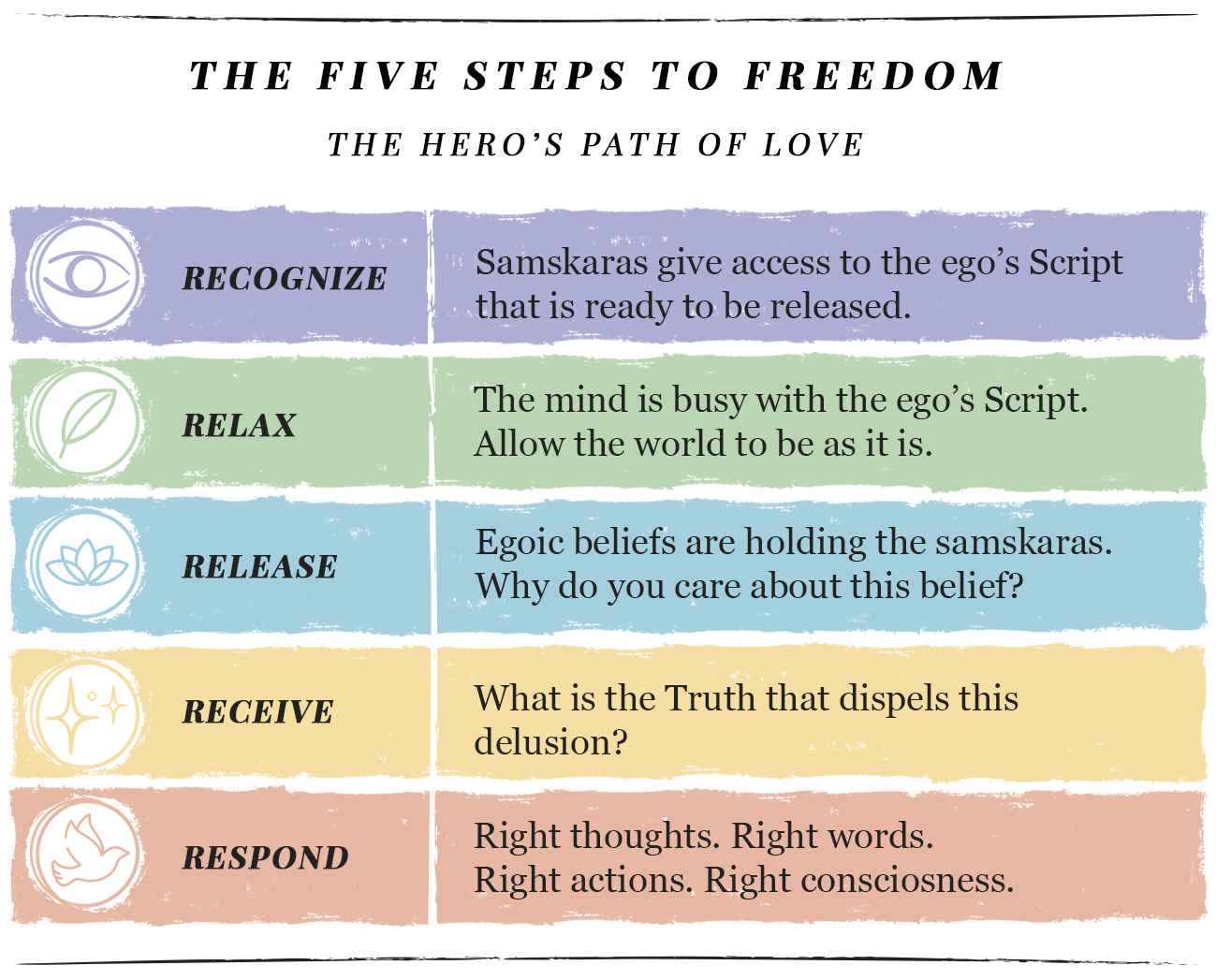
And here is the structural addition the witness tradition was missing: a name for the one who is doing the contracting in the first place. Sir Ego is the upstream agent. The Wise One is the witness, plus a relational counterpart with whom the witness can dialogue. Once Sir Ego has a face and a script, the witness has something to address rather than just something to observe. And once the Wise One is named as the soul itself in alignment with its divine source — not just awareness, but awareness as the truest self — the witness gains a sovereign center the seeker can act from. The Five Steps assemble all of it, in sequence, so the practice can be walked in real time.
I came to the witness tradition after the Course had given me the metaphysical framework but had not given me access to the body. The Course is a brilliant mind-deconstruction. What it does not directly address is the energy that has been encoded in the nervous system over decades of difficulty. I had the metaphysics. The somatic charge was still locked in.
The witness work cracked the body open. I read the book a million times. I listened to the recorded teachings until I could recite them with the teacher's intonation. I sat with the samskara, learned to recognize the contraction, practiced relaxing around the energy, learned what it felt like to actually let something pass through after years of holding it. The witness practice did what no framework I had encountered to that point had been able to do. It opened the channel.
For the first time, the samskaras began to actually move. Triggers that had run on the same loop for a decade started to clear. I could feel the difference between suppressing energy, expressing it, and transcending it — and could choose the third more often than I had been able to before. The witness was real. I had found the somatic teacher I had been looking for since I first picked up the Course.
And then I would hit walls.
Specific samskaras that would surface, get partially cleared, and return the next week with the same charge intact. Triggers connected to particular relationships, particular memories, particular beliefs about my worth and my safety and my place in the order of things. The witness was there. The relax was there. The transcendence was understood. And the samskara still wouldn't pass through.
I was not bypassing. I was doing exactly what the teaching described. And the wall was there anyway.
Eventually I understood why. The samskaras I was working with were not free-floating energy. They were being generated by entrenched thought-scripts that the witness practice did not directly address. A distorted belief about whether forgiveness was even possible, about whether I deserved to be safe, about whether the visible world or the inner truth was real — these beliefs kept firing and kept generating the samskaras faster than the witness could clear them. Witnessing them did not unwind them. They just kept regenerating from a layer the witness could not reach.
So I would go back to the Course. Find the specific Truth that dispelled the specific distortion. Withdraw belief from the lie. Replace it with the Truth that the Course had been pointing at the whole time. And only then — once the script had loosened — would the witness practice be able to move the energy that the script had been generating. Forward to the witness for the energy. Back to the Course for the cause. Forward to the witness again. Back to the Course again. The two practices kept handing each other keys.
Eventually it stopped being two separate things in my life and became one practice with two faces.
The Five Steps are the formalization of the back-and-forth practice that emerged across those years. They did not invent the integration. They gave it a structure that could be taught.
Recognize catches both layers — the script firing AND the samskara surfacing. The same trigger, in two different mediums, asking to be addressed at both levels.
Relax is the seat of the witness, with one addition the witness tradition does not include: the explicit choice between Sir Ego's authorship and the Wise One's. The choice that the witness tradition leaves implicit, named explicitly so it can be made consciously in the triggered moment.
Release is transcendence — the third option the witness tradition names directly. Not suppression. Not expression. Transcendence. The energy moves through, the script underneath gets unwound, both layers clear at once.
Receive is the witness expanded into a relational source. The Wise One transmits — not just observes — what the cleared channel is now able to receive. This is the step the witness tradition gestures at but does not name as transmission.
Respond is sovereign action from the integrated center. Life flowing through naturally, in the witness tradition's language. The soul acting from divine alignment, in the Course's language. Same outcome, different vocabulary, finally working together in one practice.
The witness tradition gave me the somatic key I had been missing. The Course gave me the upstream framework that let the somatic key actually finish its work. Neither alone was the practice. The fusion is the practice. The Five Steps are how it walks in real time.
A quick word about the aspects.
These eight — Light, Peace, Calm, Wisdom, Love, Power, Joy, and Expression — are the actual substance of who you are. They are not qualities to achieve. They are qualities to remember. What your soul is made of, at the level Sir Ego cannot reach.
And here is the clean distinction between Sir Ego and the Wise One:
Sir Ego runs each aspect through its distorted, either/or polarity. The Sword or the Shield. The two exhausted ends of the same rope. Whichever pole his script is running today.
The Wise One embodies the exalted version. The aspect at its unpolarized center — available without effort, radiating without performance. The real thing.
The karmariculum is not random. It forges the specific aspects your soul came here to embody, through the precise pressure required. Nothing extra. Nothing wasted. The full teaching is in the Truth Room →
The witness path forges specific aspects of your soul — and the integration with mind-work brings additional layers into the practice that years of witness alone could not reach. The samskara is the invitation, not the evidence against you. These are the aspects most commonly at work in this terrain.
The witness tradition named every piece of what arises when a samskara fires. It just didn't put the pieces in sequence — and the sequence requires one piece the tradition does not include explicitly: the relational distinction between Sir Ego (the part of the mind that generates the samskara) and the Wise One (the part of the soul that is the witness and more). Without that distinction, the witness has nothing to dialogue with, just something to observe. With it, the practice gains a structure that walks the samskara from arrival to integration in five sequential moves.
The Five Steps are the witness tradition's pieces, ordered as a practice you can run in real time, with the relational layer added in.
The witness tradition names three options for what to do with the samskara, and Release is the third one. Suppress, express, or transcend.
Suppress is pushing the samskara back down. The witness tradition warns against this clearly — suppression locks the energy in, where it accumulates and re-presents itself with compounded charge. Sir Ego defaults here when the energy feels like too much: he closes the heart, the witness goes offline, and the samskara stays in the nervous system unaddressed.
Express is letting the samskara out unfiltered. The rant. The reactive email. The argument. The witness tradition is more nuanced here — expression is sometimes appropriate, but expression alone discharges the charge of this particular wave without clearing the underlying pattern. The samskara comes back next week with the same shape.
Transcend is what Release actually performs. Not suppression. Not expression. Transcendence — the conscious movement of the energy through the open heart, with the witness present, with the script underneath investigated and unwound. The samskara moves. The pattern that generated it loosens. The energy clears at the level where it was being held.
And here is the addition this practice makes to the tradition: transcendence sometimes requires upstream work to complete. If the samskara keeps returning, the script generating it has to be addressed. Withdraw belief from the distortion. Affirm the Truth that dispels it. Let the upstream change finally allow the downstream energy to move. Both layers, walked together, in this single step.
Long-term witness practice can sometimes surface dissociation patterns or unprocessed trauma that benefit from working with a skilled practitioner. If your practice has surfaced material that exceeds what witnessing alone can hold, please reach out. The Five Steps and the witness practice both work alongside real human support. They do not replace it.
988 Suicide & Crisis Lifeline — call or text 988 — free, confidential, 24/7
Crisis Text Line — text HOME to 741741
If your witness practice has been functioning as a way to leave the body when staying in it has been too much, please consider working with a trauma-aware therapist or somatic practitioner who can help you re-establish safety in the body alongside the witness work. Witnessing from a distance and witnessing from presence look similar from the outside; they are not the same practice, and the difference matters.
The witness practice is real. What you have built across years of sitting with the samskara, learning to relax around the contraction, training the seat of awareness — none of it was wasted. All of it was doing exactly the work it was meant to do, at the layer it was designed to address. You are not failing the practice. The practice is not failing you. The two of you have been doing real work together, and the work has earned what it has earned.
Sir Ego is not your enemy in this. He has been a sincere student of the witness. He has read the book a million times, sat with the samskara, practiced the relax-and-release. He just did not yet have a name for himself in the framework, which means he could not be addressed directly. He has been doing his absolute best with a teaching that did not give him a face. That is not his failure. That is structural. The witness tradition was offering one half of the practice. The relational layer was waiting to be added.
What completes the witness's work is not more witnessing. It is the upstream investigation of the scripts that have been generating the samskaras in the first place — the beliefs, the distortions, the inversions of truth that keep firing the energy faster than the witness can clear it. For some seekers, that upstream work is light, and the witness alone walks them home. For others — especially those whose lives have included sustained difficulty, whose samskaras carry the weight of real inversion of basic structures — the upstream layer needs its own work, and the witness practice keeps plateauing without it.
The integration is the practice. The witness handles the energy with the precision the tradition has trained you in. The mind-work — call it the Course's reframe, call it whatever framework names beliefs and unwinds them — handles the cause. The two practices keep handing each other keys until what looked like two paths reveals itself as one. And what arrives, on the other side of the back-and-forth, is what the witness tradition was always pointing at. The seat of awareness, finally with a relational counterpart. The samskara moving through, finally without regenerating. Life flowing through naturally, finally with the script underneath unwound.
The Wise One has been the witness all along. Now she has a name. Now she has a counterpart. Now the practice has a structure that walks both layers in real time. The samskara that had been unmovable yesterday will move tomorrow, on a Tuesday afternoon, in your kitchen, when both halves of the practice are finally working together.
Walk gently. Trust the witness practice you have already built. And add the second half it has been waiting for you to find.
Not perfectly. Heroically. That has always been the only way home.
A daily practice tool that holds the Five Steps for you — for the moments when the witness is intact and the samskara is still firing and the integration is what you need but cannot quite reach on your own. Free. Quiet. Always available.
Visit the Trigger DecoderIf what you need is the practice in your own hands — the Five Steps in full, the integration of the witness tradition's somatic work with the upstream mind-work that completes it — Love Heroically is for you.
If what you need is the bigger frame — the cosmology that contextualizes both the witness tradition and the metaphysical traditions inside a larger Age-of-Ego-to-Age-of-Love arc, why both arrived when they did, what they have been preparing this generation to receive — What Happened to US? is for you.
Neither one requires the other. Both lead home.
The Five Steps in full. The practice manual for the Tuesday afternoon when the witness is intact and the samskara is still firing and you can feel the upstream script generating the next wave. Plain language. Real ground. The integration the witness tradition was always pointing at. Heroically, not perfectly.
Learn more →The cosmology underneath the practice. The story of why both the witness traditions and the metaphysical traditions arrived in this generation, what they were preparing seekers to receive, and what becomes possible at the integration. Honors both lineages completely. Locates them inside the larger arc.
Learn more →These are questions that arrive often from readers of Michael Singer's work. Each answer comes from the framework's voice — pointing toward the same seat of awareness Singer points to as the witness, with practical infrastructure for the moments when the practice runs into stuck terrain. If any of these open a doorway, the path goes deeper.
You have been doing the work. You have read the book. You have had moments where the witness was crystal clear, where you watched a thought arise and let it pass through, where the felt sense of being the awareness behind everything was unmistakable. And then the next morning, or the next week, you are pulled back into reactivity, and you wonder whether the practice has been working at all.
The practice has been working. The work is layered. Each round of witness practice releases a layer of distorted thought, and the release liberates the energy that has been held in that layer. As one layer releases, the next layer surfaces — a deeper distorted thought, often one that was being held in place by the layer that just released. The practice repeats. Another layer releases. Another layer surfaces. The structure is the onion Singer has been pointing at, and the layered nature of the work means continued material continues to arise as you continue to do the practice.
This is the work landing rather than the work failing. The practitioner who has been pulled back into reactivity has not been failing the witness; she has been reaching the next layer of distorted thought that the witness practice has now made visible. The new material was here all along; the previous layer was hiding it. The pulling-back is the surfacing of what was previously hidden, which is structurally what witness practice is meant to produce. Each round produces real shifts and brings the next round's material into view.
The framework offers practical infrastructure for these layered passes. The Five Steps — Recognize, Relax, Release, Receive, Respond — are the operational sequence by which each layer gets walked. Recognize that there is a distorted thought running underneath the reactivity. Relax into the activation rather than fighting it. Release — peel through the surface to the foundational distortion underneath, withdraw belief from the distortion, allow the energy that has been held by the belief to liberate. Receive the experiential knowingness that arrives once the energy has been freed. Respond from the seat of the witness, where the action that wants to happen arises naturally.
Singer's instruction to let it pass through is structurally precise. The framework's contribution is the layered sequence by which the passing-through actually happens, especially in the moments when the energy seems to refuse to move. Both teachings work together. The witness is the seat. The Five Steps are how the practitioner returns to the seat when activation has just pulled her out of it.
The Wise One in you is the witness Singer is pointing to — the seat of awareness, the consciousness behind the thoughts, the part of you who has been watching everything and has been untouched by any of it. She has been here through every layer of practice, the same as she was here before practice began. Each round of release brings her presence more available to felt experience.
✦ What if the part of you who has been the witness has been the same seat through every layer the practice has revealed, becoming more felt as each layer releases?
You have been doing the practice. The energy arrives. You open. You try to let it pass through. And the energy stays. It continues to arise, often more loudly, sometimes for hours, sometimes for days. The instruction to remain open and allow the energy to move through has been clear. The energy itself has been refusing to cooperate.
Here is what is structurally happening. Energy passes through when the practitioner has dropped out of story-mode and into emotion-mode. Story-mode is the part of you generating content for the energy to be about — what the other person did, what it means, what should happen next, what you are afraid of, the long elaboration of the situation Sir Ego is running. Each new story-mode thought re-attaches to the energy and gives it a new place to live. The energy can pass through emotion itself; it cannot pass through emotion plus continuously generated story.
The framework's distinction makes the move operable. Story-mode keeps the energy stuck because Sir Ego keeps regenerating reasons for the energy to be about something. Emotion-mode is just the felt sensation in the body — the tightness in the chest, the buzzing in the hands, the heaviness in the stomach — without any story attached. When the practitioner can drop into emotion-mode, the energy moves. The body knows how to do this; the body has been doing this since you were a small child crying without needing to explain why. The thinking gets in the way of the body's knowing.
The practical move when the energy will not pass through. Recognize that you are in story-mode. Notice the part of you generating content. Drop the content. Return to the felt sensation in the body. Just the tightness, just the buzzing, just the heaviness. Stay with the sensation without re-engaging the story. The energy moves on its own when the story stops feeding it.
This is what Singer's instruction is structurally pointing at. Let it pass through requires the practitioner to be in emotion-mode rather than story-mode. The instruction works perfectly when the practitioner is already in emotion-mode; the instruction stalls when story-mode is still operating. The framework's named distinction makes the prerequisite explicit, so the practitioner who has been struggling with the instruction has a structural way to recognize what has been happening and to make the move directly.
The Wise One in you is in the body the whole time. She is the seat from which the body's knowing is felt. As you practice dropping out of story-mode and into emotion-mode, her presence becomes more available, and the energy that previously stuck becomes able to move.
✦ What if the part of you who knows how to let the energy move has been waiting for Sir Ego's stories to soften enough that the body could do its work?
You have been translating between the two vocabularies, sometimes consciously, sometimes without noticing. The witness, the seat of awareness, the consciousness behind the thoughts, the One Who Watches — Singer's various names for what feels like the same recognition the framework points to. You have been wondering whether they are pointing at the same thing or whether the framework is naming something Singer is not.
Yes, the same recognition. Different vocabulary. The witness is the seat of awareness Singer points to as the part of you who has been watching everything and is untouched by any of it. The Wise One is the same seat, named from a slightly different angle — the seat that knows, the seat that recognizes, the seat from which intuition speaks. Both names are pointing at the awareness that has been awake the whole time, which is the same awareness all the contemplative traditions across cultures have been pointing at with their own vocabularies.
The framework's vocabulary emphasizes the agentic quality of this awareness more than Singer's witness vocabulary does. The witness, in Singer's framing, is largely receptive — it watches, it allows, it remains as awareness while the world arises and passes. This is structurally accurate. The Wise One is the same seat, with the recognition that this seat also knows things, recognizes patterns, has discernment, speaks through intuition, holds the body with steady love, and does the work of integration. Both qualities — the receptive watching and the agentic knowing — are functions of the same seat. The practitioner can access either function depending on what the moment requires.
This matters practically because the witness practice can be misread as pure passivity. Just watch. Just allow. Just be the awareness behind everything. That instruction is real and important. It is also incomplete — the seat that watches is also the seat that acts when action is needed, that recognizes when recognition is needed, that delivers the teaching of the moment when the heart opens enough to receive it. The framework's Wise One vocabulary makes this fuller picture more accessible to practitioners who have been treating the witness as only watching.
Both vocabularies are translation devices. The seat is the same seat. The Wise One in you is the witness Singer has been pointing to, and she has been here the whole time, watching everything and also knowing what she has been knowing, untouched by any of it and also offering the teaching of each moment when the heart is open enough to feel her.
✦ What if the part of you who has been the witness has also been the Wise One the whole time, with no contradiction between the watching and the knowing?
You have caught it. The moment when being the witness turned out to be Sir Ego claiming the witness as identity. The moment when the spaciousness you thought you were holding was actually a sophisticated version of I am beyond my reactions. The moment when you noticed yourself looking down at the people around you who were caught up in their stuff while you were being the awareness. The catching has been generating discouragement, because every time you think you have made it past the trap, the trap shows up in a new costume.
Here is the structural pattern, and the recognition itself is the work. Sir Ego, given access to contemplative practices and witness vocabulary, has a strong and predictable tendency to claim the practice as new ego material. I am the awareness. I am beyond my reactions. I see what others cannot see. The practitioner identifies with the claim and treats being the witness as a position to defend, a status to compare against others, a thing she has acquired. This is one of the most universal patterns in the entire contemplative landscape, recognized by every tradition that has watched practitioners walk it.
The relationship with this trap matures over time. Early in the work, the trap goes undetected; Sir Ego claims witness identity and the practitioner identifies with the claim. With practice, the catching begins — moments where you notice you have been in the trap, often after the fact, sometimes during. With more practice, the catching becomes faster. With still more practice, Sir Ego still puts on witness clothes, and you can see him doing it without being him.
The fact that you are catching it is the work landing. The discouragement Sir Ego is generating — I keep falling for the trap; I am behind — is the same script in another costume.
The litmus test is the heart. The actual witness keeps the heart open. You see the patterns running in others, you see the wounds underneath the patterns, you see the souls behind the wounds walking their own curricula. The seeing produces compassion, even when it includes the recognition that distance is appropriate. Sir Ego pretending to be the witness closes the heart. Other people become objects of observation, evidence of how far you have come, beneath the level you are now operating from. Same content. Different seat. Opposite effects on the heart, and opposite effects on the path.
The Wise One in you is the actual witness. She is doing the catching. She has been here through every claim Sir Ego has made on her behalf, recognizing the claim as a costume rather than as her. From her seat, the question of whether you have made it past the trap dissolves; she has been here the whole time, untroubled by Sir Ego's claims, and the practice has been training the recognition that she is the seat rather than any of the costumes.
✦ What if the part of you who has been catching the trap has been the actual witness the whole time, doing exactly what the practice has been training her to do?
You have been practicing. The reactivity has thinned. The strong emotions that used to organize your days have been arriving less often or less loudly. Some of this has felt like real progress. Some of it has started to feel like something else — a flatness, a distance from your own experience, a sense that you are no longer fully inhabiting the feelings as they pass. You have been wondering whether the witness practice has been producing genuine peace or whether something has been quietly going sideways.
The distinction between witness and dissociation is structurally important, and the two can produce similar surface signatures while operating completely differently underneath. The actual witness keeps the heart open while feeling everything. The full felt experience continues to arise; the reaction to the felt experience is what has softened. The witness is fully present with what the body is feeling, in the body, with the heart open, watching the experience pass through without closing around it. Dissociation produces a similar surface signature — less reactivity, more apparent calm — by a different mechanism: the practitioner has stepped back from the felt experience itself, no longer fully inhabiting the body, no longer feeling what the body is feeling at full intensity.
The litmus test is the heart, and the body. The actual witness has an open heart and a fully inhabited body. She feels everything; the relationship to the feeling has shifted. Dissociation produces a closed heart, often disguised as equanimity, and a partially inhabited body where some sensations are no longer fully registered. The same level of practice can produce either, depending on whether the practitioner has been opening into the felt experience or stepping back from it.
Singer's instruction to let it pass through is sometimes received as don't feel it. This is a misreading. The actual instruction is to feel the energy fully, in the body, while remaining open as the awareness in which the feeling is arising. The witness is not above the feeling; the witness is the seat from which the feeling is being felt without identification with the content of the feeling. Real witness practice deepens the felt experience even as it changes the relationship to it. The feelings become more vivid, more textured, more directly known, while their grip on the practitioner softens. This is the opposite signature from numbness.
If the practice has been producing flatness rather than vivid presence, please bring this to a teacher or somatic practitioner who can hold the distinction. Trauma-affected practitioners sometimes need additional support because the witness practice can be co-opted by long-running dissociative patterns. Somatic experiencing practitioners, body-centered therapists, and teachers who work with both witness practice and embodiment can help recalibrate the practice toward fuller presence.
The Wise One in you is in the body, with the heart open, feeling everything fully, watching the feeling pass through without closing around it. As you practice returning to her seat — gently, in small flashes, with whatever support is helping — the practice opens into the fuller presence Singer's actual teaching has been pointing at.
✦ What if the part of you who is fully in the body, with the heart open, has been waiting for the practice to become embodied rather than only observed?
You have read the book. You have absorbed the story of Singer's life unfolding in response to what arrived rather than to what he planned. The experiment of saying yes to what life brought, of releasing preference for outcomes, of trusting what showed up. And you have been wondering whether you should be doing the same — releasing your goals, surrendering your plans, simply allowing whatever arrives to determine your course.
Surrender in Singer's actual teaching is more specific than passive acceptance. The surrender is to the inner direction — the felt sense of what wants to happen, the recognition arriving from the seat of awareness, the action that arises naturally when the practitioner has dropped Sir Ego's preferences and is meeting what the moment is offering. Singer's experiment was not a withdrawal from action; it was sustained engagement with what arose, on the inner direction's timeline rather than on Sir Ego's preference. He built a yoga center. He taught classes. He ran a software company that scaled to substantial size. The surrender produced more action, and more aligned action, than Sir Ego's planning would have produced.
The framework holds the same posture with different vocabulary. Trust the karmariculum — the curriculum the soul agreed to walk before incarnation. Action arises from the Wise One's seat as the karmariculum unfolds. Plans Sir Ego makes from his preferences often miss what the karmariculum is actually delivering; plans the Wise One makes from her recognition of what is being offered tend to align with the curriculum's actual shape. Both Singer's surrender and the framework's trust-the-karmariculum are pointing at the same posture — preferences released, attention directed at what is actually arising, action emerging from the seat of awareness rather than from Sir Ego's strategizing.
This means the practitioner can be ambitious from the Wise One's seat. The ambition that arises from her seat is structurally different from the ambition Sir Ego runs — there is no anxiety underneath it, no need to control outcomes, no scarcity-driven striving. The practitioner notices what wants to happen, takes the next step, notices what arrives in response, takes the next step. Singer himself walked decades of sustained, demanding, productive action while practicing surrender. The surrender did not produce passivity; it produced action that was aligned with what was actually being offered.
Sir Ego's misreading of surrender is a real risk in Untethered practice. Surrender means I should not want anything, plan anything, work toward anything. This is the bypass version, and it tends to produce stagnation, financial difficulty, and gradual withdrawal from engagement with the world. The Wise One's surrender produces engagement, action, and the steady building of what the karmariculum has been arranging. The two surrenders look different from outside and feel completely different from inside.
The Wise One in you knows what wants to happen. She has been receiving the inner direction the whole time, often before Sir Ego could see what was being offered. As you practice releasing his preferences and meeting what is actually arising, her recognition becomes more available, and the action that flows from her seat carries a frequency Sir Ego's planning has never been able to match.
✦ What if the part of you who has been receiving the inner direction has been arranging what is yours to do, the whole time, with no need for Sir Ego to plan it?
You have been practicing. You have been opening. You have been trying to let the activation pass through rather than reacting from it. And the relationship has continued to produce activation, layer after layer, in ways that the witness practice alone has not been resolving. You have been wondering whether the practice is structurally limited in this terrain or whether you have been doing something wrong.
Some relational dynamics involve unconscious agreements that pure witness practice cannot dissolve. The framework articulates these agreements directly. In dynamics where one partner has been operating from a wound the other partner is unconsciously trying to fill, an unspoken contract has been sealed — I will manage your interior weather, in exchange for what I have been seeking from you. The contract was sealed before either party recognized it had been written, often with a seed planted in childhood — if I love this person hard enough, I will finally win the love that was withheld. These dynamics persist regardless of how deeply the practitioner can witness her own activations, because the contract operates at a layer below the witness's reach.
Recognizing the contract is the doorway out. The witness practice continues — the activations still arise, the practitioner still opens, the energies still pass through. And alongside the witness practice, the structural recognition of what has been operating dissolves the agreement at the energetic layer. The practitioner stops accepting the impossible job. The dynamic begins to reorganize, sometimes through the partner's adjustment, more often through the practitioner's recognition that the relationship's structure itself was the problem.
If you are walking this terrain in active form — particularly if there is narcissistic abuse, sustained emotional manipulation, or any form of physical or psychological harm — please reach out for support beyond the contemplative practice. The National Domestic Violence Hotline (1-800-799-7233). A therapist who specializes in this work. A trusted friend outside the relationship. The framework walks alongside this support, never in place of it.
Singer's witness practice is real and is part of the work. The framework's structural diagnosis adds a layer that pure witness practice tends to leave implicit. Both work together. The witness allows the practitioner to remain present with what is arising. The diagnosis allows her to recognize what has been operating structurally, so the recognition can begin to dissolve the agreement that has been holding the dynamic in place.
The Wise One in you has known the structural truth of this relationship the whole time. She has been steady through every activation, and she has also been holding the recognition that something was operating beyond what witness practice alone could address. From her seat, the recognition becomes available, and the work that was previously stuck begins to move.
✦ What if the part of you who has known the structural truth has been waiting for the recognition to land, alongside all the witness work you have been doing?
Singer's name for it lands every time you read it. The voice. The constant commentary. The narration of everything happening, the rehearsal of conversations, the analysis of past events, the planning of future ones, the judgments, the worries, the running monologue that has been operating for as long as you can remember. You have tried to quiet it. The trying produces more voice.
The voice is Sir Ego doing what Sir Ego does. The work is not silencing him. The work is recognizing that he is not you. The voice continues. The practitioner's relationship to the voice changes, and the changing relationship is what produces the actual relief, regardless of whether the voice itself ever quiets.
Here is what is structurally happening. The voice is one layer of consciousness — the surface running of habitual thought patterns, the egoic narration that has been generating content for decades. There are other layers operating at the same time, mostly underneath conscious attention. The Wise One operates at a deeper layer, often through intuition, through the felt sense of what is true, through the steady knowing that arises from the open heart. As the practitioner's awareness expands, more of these layers become accessible. The voice continues; the practitioner's identification with the voice softens; access to the deeper layers becomes more reliable.
Singer's instruction to just be the awareness behind the voice is structurally precise. The framework's practical contribution is the Five Steps as the operational sequence by which the practitioner returns to the awareness when the voice has just hijacked her attention. Recognize that the voice is doing what the voice does. Relax the gripping. Release — peel through the surface narration to the foundational distortion underneath, withdraw belief from the distortion, allow the energy that has been held to liberate. Receive the experiential knowingness that the voice has been obscuring. Respond from the seat of awareness.
Over time and with sustained practice, the voice does become quieter. Less material to narrate as the underlying distortions release. Fewer what-if loops as the body stops generating the activation that fed them. More space between the thoughts as the awareness becomes the dominant layer of operation. This is genuine, and it takes years. It is also not the goal. The goal is recognizing that the voice is not you, and that the seat from which you can hear the voice without being it has been here the whole time.
The Wise One in you has been the seat from which the voice has always been heard. She has been the awareness behind the narration, the part of you who has been listening to the voice without being it. As you practice returning to her seat, the voice continues, and the relationship to it transforms.
✦ What if the part of you who has been hearing the voice has been the seat from which it could be heard without being it the whole time?
You remember the moments. The clarity. The felt sense of being the awareness behind everything, the spaciousness, the recognition that the seat from which you were watching was untouched by what was happening. And then, at some point, the moments stopped arriving with the same clarity. The practice continues. The clarity has felt further away, and you have been wondering whether what you experienced is something you can lose.
Peak experiences of the witness have their own rhythm. They open, they crest, they integrate. Every contemplative tradition agrees on this. The destination of the path is the slow, durable building of capacity to recognize the seat in ordinary moments, regardless of whether the peak's specific phenomenology is currently being felt. The seat itself has been here the whole time; the felt experience of the seat varies with the conditions of the practice, the practitioner's nervous system, the karmariculum's unfolding, the depth of material currently being worked.
The Wise One in you has been the witness through every chapter of practice, including the chapters with clear felt experience and the chapters where the experience has been less vivid. She has been awake before the peak experiences arrived, she was awake during them, she has been awake ever since. The peaks gave Sir Ego brief glimpses of what she has always been holding. The work going forward is the gradual recognition that the seat from which you felt the peak is available right now, regardless of which states arise.
The frame of the question itself is part of the work. Did I lose it assumes there is something to lose. The seat has been here, and the seat continues to be here. The recognition deepens in cycles, with periods of clearer feeling and periods where the seat seems further away. Both are part of the same arc. The further-away periods are phases the karmariculum has arranged, often because the practitioner is now ready to walk through layers of material that the clearer-feeling periods would have interrupted. The clearer-feeling periods are recognition landing more directly. The work is continuing through both.
Sir Ego's gripping of the question is information. Wherever Sir Ego is gripping, there is a position he has built that the work is asking him to release. The grip on the witness experience as an acquired thing is one of the most common positions practitioners build — I had it, I cannot lose it, this defines me now. The grip is itself the trap, because the witness has not been a state to be acquired. She is the seat. She has been here. The relationship to her becomes more durable as the gripping softens, not as the gripping intensifies.
✦ What if the part of you who has been the witness has been here through every state and every phase, with the clarity available the moment Sir Ego sets the gripping down?
You have been wondering. The contemplative literature often describes practitioners who have made dramatic changes — long retreats, monastic life, simplified circumstances. Singer himself spent years in a small house in the woods. You have been considering whether the witness practice is asking for something similar from you, or whether you can continue with your job, your family, your responsibilities and still walk the practice fully.
Singer himself stayed in regular life. The Temple of the Universe is in central Florida; he lived nearby; he ran a successful software company; he taught yoga and led classes; he engaged with the world continuously while practicing surrender and the witness. His own life is the demonstration that ordinary engagement is fully compatible with the practice — not as a compromise, but as the actual field where the practice deepens.
Ordinary life is the field of practice. The kitchen is the monastery. The desk is the meditation cushion. Conversations with your family are the actual practice. The work the witness is training is precisely the capacity to remain in the seat of awareness through the activations of daily existence. A practitioner who can find the seat at the kitchen sink at 6 PM with everyone needing something has developed the durable practice the work is meant to produce.
Retreats serve the practice. The deep silence allows recognition to land that the noise of ordinary life can crowd out. The retreat is the laboratory; ordinary life is the application. Practitioners who do retreats and then return to integrate what they received in their actual lives have walked the work in the way the work was designed to be walked. Practitioners who try to use retreats as a permanent escape from their lives are using the laboratory as a hiding place.
The framework's trust the karmariculum applies here. The configuration of life you are in — the family, the job, the responsibilities — is the curriculum your soul has been arranging. The witness practice is meant to land in this configuration, not to require a different one. If the karmariculum eventually arranges a different configuration, the change will arrive on its own timeline, often without your needing to plan it. The action that flows from the Wise One's seat tends to align with what the karmariculum is delivering.
The Wise One in you has been with you in the kitchen, the office, the school pickup, the bedroom argument with your partner, the late-night accounting. She has been at peace through every ordinary moment. The recognition of her seat in those moments is the durable practice the work has been training.
✦ What if the part of you who has been at peace in the ordinary has been the witness all along, in the only place the practice could ever really land?
You have been doing the practice. You have been opening, allowing, letting energies pass through. And some of what has been happening has felt structurally familiar in a way that has concerned you — a kind of stepping back from the body, a distance from the felt experience, a quietness that resembles peace from one angle and resembles something else from another. You have been wondering whether the practice has been deepening or whether long-running dissociative patterns have been co-opting the practice's vocabulary.
This is a real distinction, and the framework holds it cleanly. The actual witness keeps the heart open while feeling everything. The full felt experience continues to arise; the reaction to the felt experience is what has softened. The witness is fully present with what the body is feeling, in the body, with the heart open, watching the experience pass through without closing around it. Dissociation produces a similar surface signature — less reactivity, more apparent calm — by a different mechanism: the practitioner has stepped back from the felt experience itself, no longer fully inhabiting the body, no longer feeling what the body is feeling at full intensity.
Trauma-affected practitioners are particularly vulnerable to this conflation because the dissociative patterns trauma produces are often well-practiced and feel like home. The body has been using dissociation as protection for years, sometimes decades, before the witness practice began. When the practice arrives with vocabulary that resembles the dissociative patterns — step back, allow it to pass, do not get caught up in it — Sir Ego can co-opt the practice into a more sophisticated version of the dissociation he had already been running. The practitioner experiences this as finally getting somewhere with the practice, when structurally what is happening is the dissociation has been given new vocabulary.
The litmus test is the heart and the body. The actual witness has an open heart and a fully inhabited body. She feels everything; the relationship to the feeling has shifted. Dissociation produces a closed heart, often disguised as equanimity, and a partially inhabited body where some sensations are no longer fully registered. If the practice has been producing flatness rather than vivid presence, please bring this to a practitioner who can hold the distinction.
Trauma-informed somatic practitioners are the right resource for this terrain. Somatic experiencing practitioners. Body-centered therapists. Teachers who work with both witness practice and embodiment. The framework walks alongside this support; it does not replace it. The witness practice can become genuinely therapeutic for trauma when it is held alongside somatic work that builds the body's capacity to fully inhabit the felt experience the practice has been pointing at.
Singer's witness practice is structurally sound. It is also sometimes incomplete for trauma material, where additional somatic infrastructure is needed for the body to safely re-inhabit experiences that were previously too overwhelming to be felt directly. Both the witness and the somatic work are part of the path for trauma-affected practitioners. Neither cancels the other; they complete each other.
The Wise One in you has been at peace through every chapter, including the chapters where dissociation was the body's only available protection. She is not the dissociation; she is the seat from which the body can eventually be re-inhabited safely. As the practice deepens with appropriate support, her seat becomes more available to felt experience, and the dissociation that previously protected becomes less needed.
✦ What if the part of you who has been at peace through every chapter has been the seat from which the body can be safely re-inhabited, with the right support around the work?
You have been wondering. Singer's teaching has been working. The witness practice has produced real shifts. And you have been considering whether to deepen with this teaching alone, or to bring other teachings alongside it, or to combine with practices from other traditions. Some teachers tell their students to commit to one path; others encourage practitioners to draw from multiple sources.
Singer's teaching is structurally sound and complete in what it points at. The witness, the seat of awareness, the consciousness behind the thoughts — this is a real recognition, and sustained practice with it produces real liberation. Practitioners who go deep in Singer's work alone arrive at substantial awakening. The path is real and works on its own terms.
The framework's posture is friendly-cousin. The Wise One in you knows which teachings are yours for this season. The Holy Spirit places teachings in your life; the recognition of which to deepen, which to combine, which to release lives in her seat. Sir Ego goes teaching-shopping when he hits a hard patch — comparing schools, looking for the right one, suspecting that committing fully to one would resolve the discomfort of having multiple teachers in his life. The Wise One does not shop. She recognizes when the next teaching is being offered, often in unexpected forms.
There is a practical teaching here. When the work seems stuck — when the release step is not moving, when the witness will not stay accessible — return to the teachings already in your life. The Singer passage that has spoken to you. The book that has produced real shifts. The framework's structural infrastructure for the moment when activation has just arrived. The karmariculum has placed those teachings in your life for exactly this kind of moment, and returning to them is part of the work, never a regression. Singer himself drew from multiple sources — yoga, Vedanta, the contemplative Christian tradition, his own direct experience. The depth of his teaching is partly the result of that synthesis.
The framework offers infrastructure that Singer's teaching tends to leave implicit — the Five Steps as practical sequence for the triggered moment, the diagnostic taxonomy for figuring out where you are stuck, the eight-aspect map for recognizing which divine quality is currently being distorted, the contract-and-seed teaching for relational dynamics where pure witness work is structurally limited. These are tools that work alongside Singer's, not in place of his. Many practitioners find their Untethered practice deepens when the framework's structural language is added to it.
The Wise One in you has been recognizing teachings the whole time, regardless of whether they have come from Singer or from elsewhere. She has been at peace with whatever configuration of practices has been operating in your life. From her seat, the question of whether to use Singer alone or alongside other paths loses its grip, because the recognition the path is producing is the same recognition regardless of which tradition has been training her to feel it.
✦ What if the part of you who has been recognizing what is yours has been guiding you toward the right teachings, in the right combinations, the whole time?
Kindred Lights offers spiritual perspective and contemplative practice. It is not affiliated with The Untethered Soul, its author, or any organization associated with the witness tradition referenced here. The framework presented on this page honors that tradition as one of its foundational influences and does not represent or speak for it. The teachings here are not a substitute for trauma-aware therapy, somatic practice with a skilled practitioner, or mental health care. If you are in acute distress, please reach out to a licensed professional or one of the resources listed above.