 Kindred Lights
You can solve the problem. You usually do. And somewhere along the way, the work that was supposed to mean something started to feel like a battlefield. The meetings that should have ended an hour ago. The email threads that run fifteen rounds. The colleagues who used to bring you their real work and now bring you only what they can defend. This is for the professional who is good at their job, exhausted by their job, and beginning to suspect the script underneath the expertise is no longer working.
You are good at this. That is part of what makes it so disorienting. The credentials are real. The track record is real. The results are real. And still, the days that should have felt like wins feel like recoveries. The meetings that resolved technically did not resolve relationally. The promotion that should have been a celebration arrived already exhausting.
You walk into the conference room — or the Zoom, or the Slack channel, or the inbox — and within ninety seconds you can feel it. Who is positioning. Who is holding back. Who is going to repeat what you already said, in their own words, after enough meetings have passed that they can claim it. The political math. The careful tracking of who said what when. The energy it takes to navigate any of this on top of the actual work. By the time the real problem gets addressed, you have already spent half your nervous system on the meta-game.
And somewhere underneath the fatigue is something quieter that you do not let surface during the workday because you cannot afford to feel it while you are still on the clock. The colleagues who used to be friends and are now careful around you. The team you would do anything for, who flinches a little when you walk in. The talented person you keep meaning to mentor whose project keeps somehow getting reabsorbed into yours. The deep weariness of being the one who has to be right, again, in a room where being right is no longer producing what being right used to produce.
You are not failing. The job is going well by every measurable standard. Something else is happening — something that the performance review will never name, that the salary will not compensate for, and that no amount of additional competence is going to solve. Because the script underneath the competence is no longer working. And on some deep level, you already know that.
Sir EgoYour ego. The hero with the wrong map.'s workplace script is one of his most sophisticated operations — because it has been getting paid for it. For years. With promotions, with raises, with the quiet authority that comes from being the person other people defer to.
The script reads itself like a duty. My job is to be the smartest person in the room. My job is to have the right answer. My job is to be so indispensably competent that my position here is permanent and unassailable. He has organized his entire professional identity around this. The credentials, the track record, the reputation — all of it in service of the script.
And the script has worked. He is competent. He does have the right answer much of the time. The results are real and his career has rewarded him for them. From the inside, the script does not look like a script. It looks like character. It looks like work ethic. It looks like the very thing his profession is supposed to value.
What is also real, and what the script cannot easily see: the colleagues who have stopped bringing him their real problems because his certainty leaves no room for theirs. The meetings that feel like verdicts. The email threads that run fifteen rounds because nobody wants to be wrong first. The talent that never quite gets developed under his leadership because developing it would mean admitting he did not already have the answer. The slow, almost-invisible cost the script has been extracting from every relationship in the building, including his own.
And underneath the competence, running so quietly that he has never had to consciously hear it, is the sentence that has been driving the whole operation: if I am not valuable, I am in danger.
Listen for that sentence. It is the diagnostic. The certainty that has to win every meeting, the inability to delegate the project that someone else could legitimately do, the small jolt of threat when a colleague gets praised for work that could have been yours, the fifteen-round email thread you cannot stop yourself from finishing — all of it is one script, running the same line underneath, generating the same fear-driven competence the whole way down. If I am not valuable, I am in danger.
Sir Ego is not bad for running this script. He learned it somewhere — usually early, usually from a context where being valuable was, in fact, the only protection available to a small person in a large situation. The script has been keeping him alive in his own private architecture for decades. He has been brave. He has been loyal. He has been working on your behalf the whole time, with the only map he had. He just does not realize, yet, that the map he has been using does not lead where he thinks it leads. It leads to a corner office where the person sitting in it is too exhausted to enjoy the view, and too afraid to put the script down because the script is the only thing he believes is keeping him there.
Sir Ego's script says: if I can just get them to see the right approach, we can move forward. The resistance is the problem. The other people are the obstacle. The work would be easy if everyone else would just cooperate with the obvious correct solution.
The Script of CreationThe living intelligence running the universe. is running something else entirely: the resistance is information. The person across the table has a wound, a script, a legitimate perspective that your certainty is preventing you from hearing. The obstacle is not them. The obstacle is the fear underneath the competence that cannot get out of the way long enough to let the real collaboration happen.
The collision fires every time Sir Ego is right and right still does not work. Every time the correct answer produces conflict instead of alignment. Every time the expertise that should solve it makes it worse. Every time he wins the argument and loses the colleague. Every time the proposal that was technically airtight gets quietly deprioritized in favor of something less elegant from someone less certain. The script cannot account for any of this — because the script believes that being right is supposed to be enough.
It is not. Being right has never been enough. The most intelligent move available in any room is almost never the technically correct answer delivered by the most certain person in the room. It is the answer that emerges when the person with the most expertise is also the person most willing to be wrong, most willing to listen, most willing to let someone else arrive at the conclusion at their own speed. That is not a soft skill. That is the hardest skill there is. And the script has been preventing Sir Ego from developing it, because the script reads any moment of not-knowing as danger.
The KarmariculumYour soul's custom lesson plan. is asking the question Sir Ego has built his career around not asking: what if being effective is different from being right? What if the work I am actually here to do is to see the human before I solve the problem? What if the authority I have spent decades earning is not the kind of authority I think it is?
And the part Sir Ego cannot quite hold from inside the script: noble qualities — genuine curiosity, the willingness to be wrong, the patience to let someone else arrive at the answer in their own time, the simple human warmth that turns a meeting into a conversation — do not have to be manufactured. They are not skills to acquire. They are not behaviors to perform. They arrive on their own when Sir Ego stops blocking them with the need to be the most important person in the room. The expertise is real. It will not go away. What will go away is the exhausting performance of expertise, replaced by the much quieter expression of expertise in service of the actual work.
The opening, when it comes, is rarely inspiration. It is usually exhaustion. The moment Sir Ego is too tired to keep running the script — too tired to win the meeting, too tired to finish the fifteen-round email, too tired to defend the position that no longer needs defending. And in that exhausted moment, the Wise OneYour higher self. Already home. has room to move. Not as a different person. As the same person, finally available to do the work the script has been blocking the whole time.
I was the most competent person in most rooms I walked into. And I needed everyone to know it.
Not because I was arrogant — I genuinely thought I was being helpful. I had the right answer. I could see the solution. I could not understand why people kept resisting the obvious correct approach. The MBA, the CPA, the years in banking, the hours of preparation that nobody else was doing. I was carrying the room. The least anyone could do was let me.
The meetings became battlegrounds. The emails became volleys. The colleagues who should have been allies became obstacles. Real ones. Smart, capable people whose only crime was that they were trying to advance their own ideas in a room where I had already concluded my idea was the correct one. I spent enormous energy being right — and enormous energy recovering from the damage that being right kept causing.
The workplace was where Sir Ego ran his most sophisticated operations. The Fixer. The Expert. The one who could optimize anything. The person who, under all the visible competence, was running a script that said: my job is to be smart and show the right way. My job is to be the person they cannot do this without.
And underneath that, the line that drove all of it: if I am not the most valuable person in the room, I am in danger.
I did not hear that line consciously for years. I just felt the urgency of it. The slight panic when a colleague got praised for something I could have done. The inability to fully delegate. The way I would replay meetings at night, three times, looking for what I should have said differently, what I should have said better, what I should have made sure they understood. The career was successful by every external measure. The interior was a slow, quiet, professionally-decorated war.
The shift did not start at work. It never does.
It started in a jail cell. In a forgiveness circle. In the specific daily work of keeping the table clean with a teenager who needed me to stop fixing her. By the time I tried to bring any of it into a conference room, I had been working on the same script in three other arenas for years. The workplace was not where the practice began. The workplace was where the practice finally got tested at the level it was always going to have to be tested at — because the workplace was where the script was getting paid.
One particular standoff. A conflict with a colleague that had run for nearly a year. Two people who should have been collaborating, who had instead become a case study in how organizational politics turn into trench warfare. I had right on my side. I had the documentation. I had the chain of email evidence. I had every receipt I would ever need to win.
I went into the meeting prepared to win. And somewhere in the first three minutes, I did something I had not planned to do. I got real. I acknowledged their point of view as legitimate, before I had been forced to. I named where I had been operating from fear instead of clarity. I stopped needing to be right. I asked for help.
Something in me had opened that stayed open. The colleague — who had been holding their own version of the same script the whole time — opened in response. The conversation that none of the prior twelve months of meetings had produced happened in forty-five minutes.
And I began to see something that the script had been hiding from me my whole career. I did not have to try to be good. The qualities I had assumed I needed to manufacture — patience, genuine curiosity about the person across the table, the willingness to be wrong, the simple human warmth that turns a meeting into a conversation — were not skills I needed to develop. They arrived on their own the moment I stopped blocking them with opinions and judgments and the urgent need to be the most important person in the room.
The obstacle had never been a lack of competence. It had been the fear underneath the competence that could not get out of the way.
The people who had been obstacles became people.
I stopped needing them to be different before I could show up. I started seeing my job as honoring the person in front of me first, and completing the task second — and discovered, to my genuine surprise, that the second one happens almost effortlessly when the first one is in place. The results that a year of fighting had not produced resolved in a single open-hearted conversation. Not because I had figured out a clever new approach. Because I had finally stopped running the old one.
This is still my practice. Sir Ego still wants to be right. He still has opinions about the most efficient approach. He still occasionally runs the old script when the stakes feel high. But the Wise OneYour higher self. Already home. has learned that the most efficient approach is the one that sees the human first. And Sir Ego, in his right relationship to the Wise One, has found that he is more useful, not less, when he is no longer the one driving.
The work got better. The relationships got better. The results that had been the whole point of the script started arriving more easily once the script was no longer the engine producing them. And the thing I had been trying to manufacture through competence my whole career — the felt sense of actually mattering, of being genuinely useful, of doing work that meant something — arrived naturally, without effort, the moment I stopped trying to earn it.
The expertise did not go anywhere. The MBA did not become less valid. The years in banking and nonprofit leadership did not get less real. Sir Ego the noble knight still brings every one of those credentials into the room with him — but he brings them now in service of the work, not in service of his own protection. He is still the smartest person in many of the rooms I walk into. He just no longer needs anyone to know it. And in the strangest paradox of the whole journey, that is the moment when people finally started letting him lead.
A quick word about the aspects.
These eight — Light, Peace, Calm, Wisdom, Love, Power, Joy, and Expression — are not qualities to achieve. They are the actual substance of who you are. What your soul is made of, at the level Sir Ego cannot reach.
And here is the clean distinction between Sir Ego and the Wise One:
Sir Ego runs each aspect through its distorted, either/or polarity. The Sword or the Shield. The two exhausted ends of the same rope. Whichever pole his script is running today.
The Wise One embodies the exalted version. The aspect at its unpolarized center — available without effort, radiating without performance. The real thing.
The karmariculum is not random. It forges the specific aspects your soul came here to embody, through the precise pressure required. Nothing extra. Nothing wasted. The full teaching is in the Truth Room →
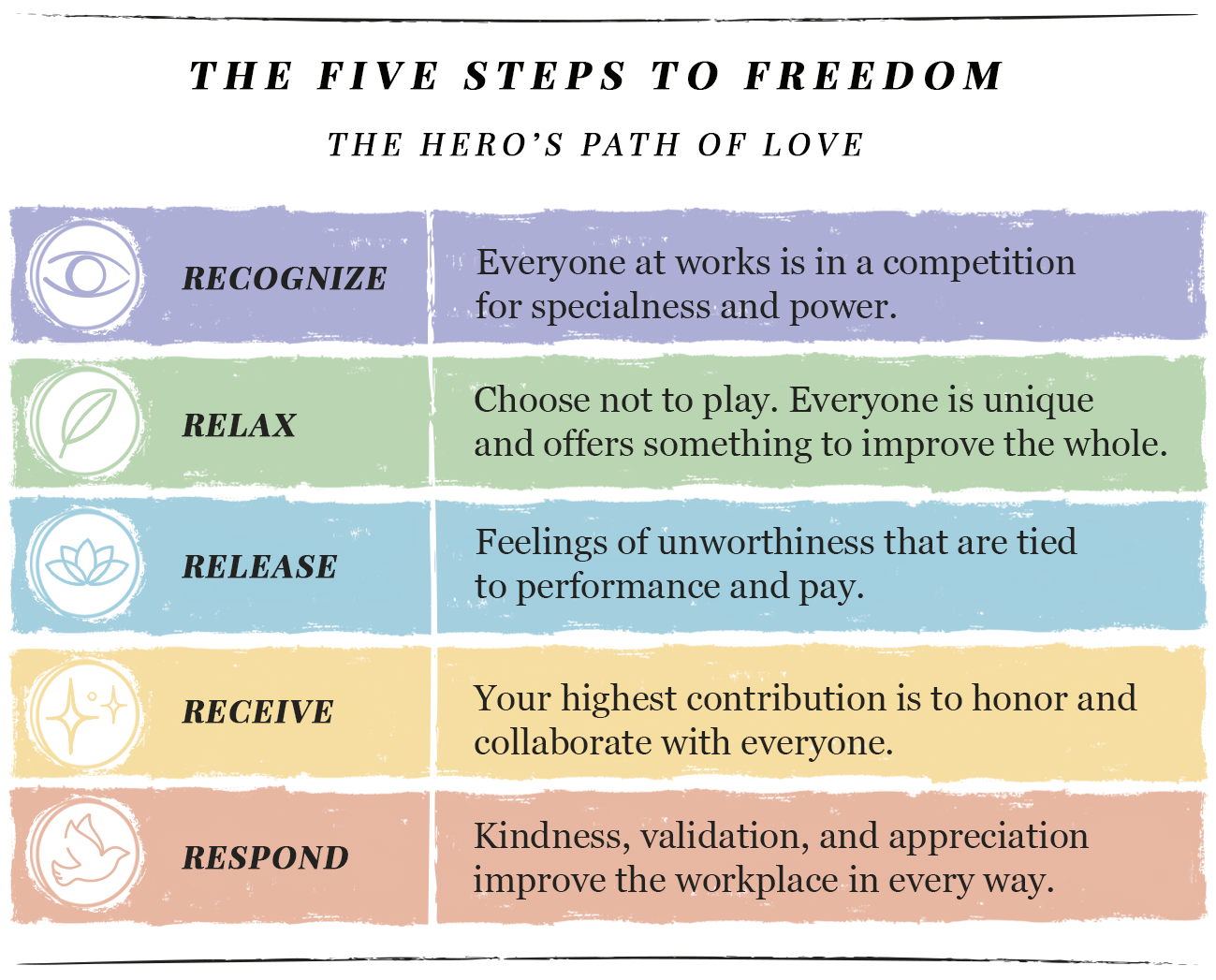
The workplace forges specific aspects of your soul precisely because the stakes are real. Compensation, status, the sense of mattering — Sir Ego believes all of it is on the line every time he walks into the meeting. The pressure is the invitation, not the evidence against you. These are the aspects most commonly at work in this terrain.
The workplace can break a person quietly, and the slow grind of professional fear is real even when nothing visibly catastrophic is happening. If the weight has become more than you can carry, please reach out. The Five Steps work alongside real human support. They do not replace it.
988 Suicide & Crisis Lifeline — call or text 988 — free, confidential, 24/7
Crisis Text Line — text HOME to 741741
If what you are facing is workplace harassment, discrimination, retaliation, or abuse, the inner work is not the only work. Document carefully. Consult HR if it is safe to. Consult an employment attorney for a confidential assessment of your rights. The U.S. Equal Employment Opportunity Commission — eeoc.gov — handles formal complaints. The Five Steps will help you stay grounded through what comes next; they are not a substitute for the protections you are entitled to.
And if you suspect you are working with someone whose behavior is patterned in a way that goes beyond ordinary workplace conflict — covert manipulation, gaslighting, sustained undermining — the Narcissistic Abuse path is the companion page that maps that specific terrain. It happens in offices as well as in marriages.
You are good at what you do.
That has never been the problem. The credentials are real. The track record is real. The years of work that brought you here are real, and they were not wasted, and they did not produce a person who needs to be dismantled. The script that has been running underneath the competence is what is asking to be set down. Not the competence itself. Just the fear that has been driving it.
Sir Ego is not your enemy in this. He is the noble knight who has carried the credential and the track record and the years of long days on your behalf. He has been working for you the whole time. He has been brave. He has been loyal. He just learned somewhere — usually early, usually in a context where being valuable was the only protection a small person had — that if I am not valuable, I am in danger. And he has been protecting you from that danger ever since, with the only tool he had.
The danger is no longer real. You are not the small person in the large situation anymore. You are the expert in the room. The script is a holdover from a chapter that is closed. He can put it down. Not all at once — that is not how scripts release. But one meeting at a time. One email at a time. One moment of catching the line if I am not the most valuable, I am in danger running underneath, and gently letting it go.
And what arrives when the script releases is not less than what was there before. It is more. The expertise is still there. The credentials are still there. The years of preparation are still there. What is no longer there is the exhausting performance of all of it. The same competence — finally allowed to do its actual work — without the constant low-grade fear that has been the cost of its delivery your whole career.
The Wise One has been waiting underneath the script the whole time. Not as a different professional. As the same professional, finally available to do the work the script has been blocking. The colleagues who flinched will stop flinching. The team that held back will start bringing their real work. The collaboration that twelve months of fighting could not produce will land in forty-five honest minutes, on a Tuesday, when nobody planned for it.
You came here to do meaningful work. That has not changed. What changes is who is doing it. Sir Ego in his right relationship to the Wise One — knight to the Lady, no longer trying to run the kingdom himself — is finally free to do what he was always best at. Serving the actual mission, with the full weight of his competence, in service of something larger than the script that has been running him.
Walk into the next meeting as that person. The work will know the difference. The room will know the difference. You will know the difference.
Not perfectly. Heroically. That has always been the only way home.
A daily practice tool that holds the Five Steps for you — for the moments when Sir Ego has just walked into the meeting and the script is louder than the teaching. Free. Quiet. Always available.
Visit the Trigger DecoderIf what you need is the practice in your own hands — the Five Steps in full, for the meeting at 2pm where the script is already firing and you have ninety seconds before you walk into the room — Love Heroically is for you.
If what you need is the bigger frame — the cosmology that explains why the workplace runs on the same mechanism as every other arena, why the Age of Ego organized work around fear in the first place, and what work looks like when the script is no longer running it — What Happened to US? is for you.
Neither one requires the other. Both lead home.
The Five Steps in full. The practice manual for the meeting that is about to go sideways, the email thread you cannot stop yourself from finishing, the colleague you cannot quite stop competing with. Plain language. Real ground. Heroically, not perfectly.
Learn more →The cosmology underneath the practice. Why the workplace got built the way it did. Why competence-as-protection runs every professional script. What the Age of Love is asking of those of us who have spent decades being valuable, and what becomes possible when the script of valuableness is finally allowed to release.
Learn more →These questions arrive often from readers wrestling with their work, careers, and workplaces. Each answer comes from the framework's voice — naming work as the polishing tumbler the karmariculum has arranged, and pointing toward the seat-shift that transforms the experience of the same job. If any of these open a doorway, the path goes deeper.
You wake up Sunday afternoon and the weight has already arrived. By evening it has settled into the chest. Monday morning the alarm rings and the dread is fully operational, organizing the body's preparation for what the day will bring. You have been wondering what the dread is telling you — whether you should change jobs, change careers, change your whole life, or whether the dread is information about something more interior than the job itself.
Here is the structural piece almost no career-advice resource names cleanly. Work is an ego hunger games, regardless of how much you love the actual work itself. Every workplace is populated by Sir Egos doing what Sir Egos do — competing for money, competing for specialness, comparing themselves to each other, organizing their sense of worth around their job. When you walk into the office on Monday, you walk into a configuration of egos, including your own, all running their scripts at full intensity. The dread is information about Sir-Ego-to-Sir-Ego operating mode, which is exhausting regardless of which job is producing it.
Sir Ego believes the solution is to find a different job. The next workplace will be better, the next role will fit, the next company will have the culture he is looking for. The search continues across years, sometimes across decades, and the dread tends to follow regardless of which job is being done. The structural truth is that the dread lives in the seat from which the job is being done, not in the job itself. A Sir-Ego-to-Sir-Ego workplace experience produces dread regardless of how meaningful the work is.
The shift is from ego-to-ego meeting to Wise-One-to-ego/Wise-One meeting. Walking into the office Monday morning, the practitioner stops meeting her coworkers Sir-Ego-to-Sir-Ego, which is what produces the hunger games dynamic, and begins meeting them from the Wise One's seat regardless of which seat they are operating from. She does her work. She brings her gifts. She stops measuring herself against the others. She stops needing the credit. The work itself does not change. The seat from which it is being done changes everything.
From this shift, the work becomes calling. Not because the job changed; because the seat from which the job is being done changed. The Wise One in you does not need the workplace to be different in order to do the work that is hers. She does the work that is in front of her, from the seat that is hers, and the dread that has been organizing your Sundays softens because the structural cause of the dread — the hunger games operating mode — has been quietly released.
✦ What if the part of you who has been at peace through every Monday has been waiting for Sir Ego to set the hunger games down so the work could become what it actually is?
You have been managing it for months, possibly years. The unpredictable temper. The credit-stealing. The triangulation, where she pits team members against each other. The undermining when you succeed. The blaming when anything goes wrong. The cycle of devaluation and occasional praise that keeps the team destabilized. You have considered leaving and the practical constraints have kept you in place, and the daily contact has been costing you more than the salary has been replenishing.
The narcissistic abuse terrain is fully addressed in the framework's Narcissistic Relationships path; if you are walking this in active form, please read those resources. The patterns are the same in workplace narcissism as in relational narcissism, and the structural understanding transfers. What follows is the work-specific contribution to that broader picture.
Practical first. Document interactions in writing where possible. Maintain professional boundaries that limit her access to your interior weather. Use gray-rock communication — brief, informative, friendly, firm — that denies her the emotional supply the pattern feeds on. Build your network outside her sphere of influence. If you are being subjected to behavior that crosses into harassment or hostile workplace, please consult an employment attorney; protections exist that the workplace will not always volunteer. HR sometimes helps; HR is also there to protect the company, and many narcissistic bosses are protected by the company because they produce results that the company values. Plan accordingly.
At the structural layer, the workplace is the polishing tumbler the karmariculum has arranged, and a narcissistic boss is one of the most intense polishing instruments available. The work is to meet her from the Wise One's seat regardless of which seat she is operating from. She may be in Sir Ego — she almost certainly is, most of the time. Your meeting from the Wise One does not require her to be different. It requires the seat from which you are meeting to be steady. The pattern feeds on emotional supply; the Wise One generates none, because she is at peace with what is. Over time, sustained meeting from her seat tends to produce one of three outcomes — the dynamic loses its hold and contact becomes survivable; the boss escalates and the structural mismatch becomes obvious to others; or the karmariculum reorganizes the configuration and you find yourself elsewhere. The framework holds all three as possible.
The Wise One in you has been at peace through every interaction with this boss. She has been the part of you who has not been organized by the pattern, who has been steady underneath every storm, who has been holding the soul of the boss while honoring the distance the situation requires. From her seat, the survival question becomes a different question — what is yours to do today, in the configuration the karmariculum has arranged, and how do you do it from the seat where you are not generating the supply the pattern feeds on?
✦ What if the part of you who has been steady through every interaction has been the seat from which this configuration becomes survivable, with no requirement that the boss change?
You have been depleted for a long time. The work that used to engage you has been draining you. The energy you had at the beginning has been gone for years. Sleep has stopped restoring you. Weekends barely recover what the week consumed. Vacations help briefly and then the depletion resumes within days of returning. You have been managing the burnout, applying the standard advice — set boundaries, take care of yourself, practice self-care — and the depletion has continued anyway.
Please honor the depletion. It is information. The body has been reporting that the configuration of work that has been required has been beyond what is sustainable, and the report is accurate. Real clinical burnout deserves clinical attention. A therapist who specializes in burnout. A physician who can rule out medical contributors. Communities of others walking similar conditions. Please use the support.
At the structural layer, burnout is often the body's report on which seat has been operating in the work. Sir Ego in the work generates a particular signature — sustained effort, pressure to perform, comparison to others, anxiety about outcomes, control of variables that cannot be controlled, identity invested in the results, generation of fear-fuel that the system cannot indefinitely sustain. The same number of hours, in the same job, run from the Wise One's seat, produces a different signature. Engagement without identification. Effort without grasping. Care without absorption. The body's response to the same work configuration is dramatically different depending on which seat is operating.
Look at where in your life you have been on fire — work that has lit you up, projects that have produced more energy than they consumed, hours that have flown rather than dragged. Whatever the activity was, the Wise One was operating it. Now look at the work that has been depleting you. Whatever the activity was, Sir Ego was operating it, doing what Sir Ego does in work — competing, comparing, controlling, performing, generating fear-fuel that the body has now exhausted itself supplying. The variable is not the work. The variable is the seat.
The shift takes time. The body's depletion is real and the body needs recovery. The practical care continues. And alongside the practical care, the work of returning to the Wise One's seat in the work itself is what makes sustained engagement possible. From her seat, the same work becomes sustainable, because the energy that was being burned on the hunger games is now available for the actual contribution.
The Wise One in you has been with you through every depleted year. She has been the part of you who has been waiting for the seat-shift that lets the work become calling rather than performance. From her seat, the work continues, and it continues differently.
✦ What if the part of you who has been waiting to do this work from her seat has been holding the version of work that lights you up rather than burning you out?
You see clearly what they are doing. The shortcuts they take. The way they treat people you respect. The decisions they make that you would never make. The values they operate from that are visibly different from yours. And you have been struggling with how to work alongside them without either compromising your integrity or letting their patterns occupy more of your interior life than they should.
The most useful distinction the framework offers in this terrain is between discernment and judgment. Discernment is the seeing of what is. The recognition that this person is operating from these values, that this dynamic has these features, that these decisions reflect these priorities. Discernment is the Wise One's natural function and is necessary for clear work. Judgment is a second step, structurally different from discernment, that Sir Ego skips into automatically. They are wrong. They should be different. This shouldn't be happening. Judgment closes the heart, ends the curiosity, locks the seer into a position.
The litmus test is the heart. Clear seeing that arrives from the Wise One's seat keeps the heart open. You see the values they are operating from, you see the wounds underneath the values, you see the soul behind the wounds walking some curriculum its own. The seeing produces compassion, even when it includes the recognition that distance is appropriate. Clear seeing that arrives from Sir Ego's seat closes the heart. The other person becomes wrong, evil, beneath you, evidence of how far you have come. Same content, different seat, opposite effects on the heart and on the working relationship.
Working from the Wise One's seat with someone whose values differ from yours produces a particular signature. You can advocate for what you believe in without performing righteousness. You can decline to participate in what violates your integrity without making the decline a moral declaration about the other person. You can do your work alongside theirs without absorbing their patterns into your own field. You can hold your position with the heart open, which produces a strange and useful effect — the other person often softens, not because you converted them, but because you are no longer engaging at the layer where they were braced for opposition.
The Wise One in you can see clearly with the heart open. She knows the difference between the soul behind the values and the values themselves. She can work alongside people whose values differ without treating them as enemies, because her clarity does not require the closing-of-heart that judgment produces. From her seat, the working relationship becomes possible, even when full agreement is not, and the work itself continues without the friction Sir Ego's judgment had been generating.
✦ What if the part of you who can see clearly with the heart open has been making the working relationship possible, regardless of how different the values are?
You have built the career. The promotions arrived. The salary is what you imagined, the title is what you wanted, the recognition is real. By every external measure that Sir Ego has been using to evaluate his progress, you are succeeding. And the felt experience underneath the success has been hollow, in a way that Sir Ego has been confused by, because his metrics have been showing what he was supposed to want and the wanting itself has stopped landing.
Here is the structural piece. The success Sir Ego has been building is built around specialness — the bid to the Creator that he is uniquely worthy because of what he can do, what he has achieved, what makes him stand out. I am special. This is my thing. Only I can do it the right way. Specialness is a comparative claim; it requires others to be less special by definition for the specialness to register. The hunger games run on specialness as the reward, and the prize for winning the hunger games is the recognition that the prize itself was structurally hollow.
Sir Ego cannot make this hollowness fill, because the seat from which he has been operating produces the hollowness as a structural consequence. The Wise One does not need to be special. She IS, and her work flows from her being-ness rather than from the specialness identity Sir Ego has been performing. Work done from her seat lands as contribution rather than as proof. The same work, with the same talent, with the same external results — and the felt experience underneath is structurally different, because it is no longer organized around Sir Ego's bid for worthiness.
The recognition you are feeling now is the karmariculum's invitation. The success Sir Ego built has produced exactly what success Sir Ego built tends to produce — visible results, hollow underneath. The work going forward is not abandoning what you have built; it is the gradual shift in the seat from which the work is being done. The promotions can continue. The salary can continue. The title can continue. The seat shifts, and the felt experience of doing the same work transforms.
Often this shift produces external reorganization on its own timeline. The work that fit the specialness-seeking version of you fits less well as the Wise One's seat builds. The next configuration arrives, often unexpectedly, often in forms Sir Ego could not have planned. You will attract what is yours. The chasing softens because the seeking that was driving it is no longer organizing your interior life.
The Wise One in you has been doing the actual work the whole time, regardless of what Sir Ego has been claiming credit for. She has been the part of you who has been at peace through every promotion and every external measurement, knowing the success was real at the surface and incomplete at the layer where the hollowness has been registering. From her seat, the question of what is wrong has a different answer — nothing is wrong. The hollowness is the karmariculum's invitation to the next layer.
✦ What if the part of you who has been doing the actual work has been the source of every real contribution, while Sir Ego was busy performing specialness in the meantime?
The signals have been building. The signs have been clear for weeks or months. Maybe a formal performance plan. Maybe the company's financial difficulties have become public. Maybe the conversations with leadership have shifted in ways that mean what they mean. The job that was your context, the income that was your foundation, the structure that was your daily life — all of it is about to reorganize, and Sir Ego has been racing through scenarios, preparing arguments, generating panic, trying to manage what cannot be controlled from his seat.
Please use the practical resources. If termination is being formalized, an employment attorney can help you understand your options, including severance negotiations and any legal protections that apply. Update your resume now. Reach out to your network now. Apply for unemployment benefits the moment you are eligible. Build your runway — review savings, cut discretionary spending, make sure healthcare coverage continues. The practical infrastructure for job transitions is well-developed, and using it is part of how this terrain is walked.
At the structural layer, the karmariculum has been arranging this. The job that is ending was part of the curriculum your soul agreed to walk; the ending itself is also part of the curriculum. The configuration that comes next is what the soul has been arranging next. This does not erase the practical difficulty — bills still need to be paid, healthcare coverage still matters, the loss is real — and it does change the felt experience of being in the transition. From Sir Ego's seat, the loss is catastrophe and threat; from the Wise One's seat, the loss is the curriculum delivering exactly what is being delivered, and the next chapter is being arranged whether you can yet see it or not.
Many practitioners report, looking back at involuntary job transitions years later, that the loss was the doorway to what came next. The job that was lost was already misaligned at a layer the practitioner had not quite been able to see; the loss made the misalignment visible and forced the reorganization that the karmariculum had been arranging. This recognition usually only lands in retrospect; from inside the transition, the loss feels like loss. Both are true. The loss is real now. The doorway it has been opening is also real, and the recognition will arrive on its own timeline.
The Wise One in you is here through this transition. She has been at peace with what is ending and what is arriving, the same way she has been at peace with every other chapter of your life. Her presence is what allows the practical actions to be taken from a steadier seat — the conversations with the attorney, the calls to the network, the decisions about what to do next. Sir Ego's panic is information about the transition's intensity; the Wise One's steadiness is what makes the navigating possible.
✦ What if the part of you who is at peace with what is ending has been arranging what comes next the whole time, with the doorway opening even as the current chapter completes?
The pull has been getting louder. The work that was once tolerable has become harder to sustain. The thing you have been thinking about — the business you would start, the art you would make, the path you would walk if you only had the freedom — has been calling you with increasing intensity. And underneath the pull is a question Sir Ego has been carrying: is this the calling I have been waiting for, or is this Sir Ego in escape mode generating a fantasy that lets him avoid what is actually difficult about my current life?
Both pulls are real, and they produce remarkably similar surface signatures while operating completely differently underneath. The litmus test is the heart, and the body. The pull from the Wise One has peace under it. There is a steady knowing that this is yours, often arriving without urgency, often deepening across months or years rather than spiking suddenly, often willing to wait for the right configuration to make the move responsibly. The pull from Sir Ego in escape mode has anxiety under it. There is urgency, often dramatic intensity, often a sense that I need to do this NOW or I will explode, often coupled with avoidance of the practical questions of how the transition would actually be sustained.
The same activity — quitting your job to pursue something else — can be walked from either seat, and the signatures are different both before the move and after. The Wise One's move tends to come with practical preparation, financial runway, careful timing, willingness to walk the transition responsibly even as the pull is followed. Sir Ego's escape mode tends to come with magical thinking, dramatic departures, the universe will provide, and avoidance of the practical realities the move requires. Both can produce the same external action; the felt experience of doing it, and the quality of what unfolds after, differs structurally.
Practical wisdom about responsible transitions: build the financial runway before the move where possible. Test the calling before committing fully — start the side project while still employed, make the art on weekends, build the early version of the business before quitting. The Wise One does not require Sir Ego to make dramatic gestures; she tends to bring what is hers into being gradually, in a way that lets the practical infrastructure form alongside the inner shift. Many practitioners who follow what turned out to be Sir Ego's escape mode regret the dramatic exit; many who follow the Wise One's pull find the transition unfolds more steadily than they expected.
The framework's attract, not chase teaching applies. The Wise One in you attracts what is yours — opportunities, configurations, the right circumstances for the next chapter — without the chasing Sir Ego had been doing. As her seat builds, the calling reveals itself more clearly, and the path forward often emerges in ways that Sir Ego's planning could not have constructed. Sometimes the calling involves leaving the current job. Sometimes it involves a different relationship with the same work. Sometimes it involves something neither you nor Sir Ego had imagined. The Wise One's recognition is what knows.
✦ What if the part of you who knows what is yours has been waiting for the urgency to soften enough that her quieter knowing becomes audible?
You walk into the office. You see the colleague who got promoted before you. The one whose work is being praised in meetings. The one who seems to have the natural ease the work requires. The one whose career has been advancing on a timeline that makes yours look slow. The comparison is automatic, fast, and exhausting — and underneath it runs a quiet conviction that something is wrong with you because your trajectory has not been theirs.
Comparison is structural ego activity. Sir Ego organizes his sense of worth through ranking — better than, worse than, ahead of, behind. The hunger games run on comparison; specialness is the prize, and specialness is comparative by definition, which means Sir Ego has to keep measuring to know whether he is winning. The measuring never stops, because the prize never lands in a way that satisfies. The Wise One does not compare. She does not need to be ahead of anyone for her contribution to be felt as worthy.
There is also a structural truth about the appearance of others having it figured out. Most of what you can see of your colleagues is their performance — the version they present to the workplace, the work they produce, the demeanor they project in meetings. What you cannot see is what is happening underneath their performance. The colleague who got the promotion is running her own scripts; the one who seems naturally easy is doing the same emotional work everyone else is; the one whose career is advancing on a faster timeline is paying costs you cannot see. The surface reading Sir Ego has been doing of their having-it-figured-out is almost always inaccurate, because the visible performance is engineered to look more put-together than the felt experience underneath it.
The shift, when it becomes available, is from comparison to recognition. Recognition of what is yours, which has nothing to do with what is theirs. Recognition of the work that wants to be done by you, which has nothing to do with the work that has been done by them. Recognition of the soul-curriculum your soul agreed to walk, which has its own timeline that intersects with theirs only by coincidence, never by competition. From this seat, the colleagues in the office are no longer reference points for measurement; they are other souls, walking their own curricula, alongside you in the polishing tumbler the karmariculum has arranged.
The Wise One in you has been doing your work the whole time, regardless of what Sir Ego has been comparing it against. She has known what is yours, on the timeline it is being delivered, in the configuration that has been arranged. From her seat, the comparison loses its grip, because the source of worthiness she operates from has nothing to do with whether anyone else is ahead or behind.
✦ What if the part of you who has been doing your work has known what is yours the whole time, with no need to compare it to anyone else's?
The conversation is on the calendar. The email is drafted. The script for what you need to say is in your head, and you have been practicing it on the drive in. The other person's reaction is unknown, and probably will be hard. You have been carrying the difficulty of having to deliver this for days or weeks, and now the moment has arrived, and you have been wondering how to do this without either becoming the cold professional who does not feel anything or the over-explainer who tries to make the difficulty land softly through verbal padding.
The Wise One can deliver hard truths cleanly because her heart stays open while doing it. The clean delivery is structurally different from the cold version and from the over-explained version, both of which are Sir Ego in different costumes. The cold version is Sir Ego closing the heart to manage his own discomfort; the over-explained version is Sir Ego trying to soften the impact through padding that often makes the hard truth harder to receive. The Wise One does neither. She speaks clearly, with the heart open, with full presence to what the other person is receiving.
Practical preparation. Be specific about the facts. Know what the next steps are. Have the practical resources ready (severance information, transition support, contact for HR follow-up, anything the other person will need to navigate what comes next). Do not deliver the hard news at the end of a meeting or before a weekend if avoidable; give the receiver time and space to process. Do not couple the hard news with positive feedback as a shock-absorber; the feedback sandwich tends to produce confusion rather than softening. State the hard truth, then make space for the receiver to respond, then deal with the practical follow-up.
The seat-work matters more than the script. Walk in from the Wise One's seat. Meet the person from her, regardless of how they receive the news. They may be angry, devastated, defensive, calm, gracious — any of which is appropriate to what you are delivering. Your meeting from her seat does not require any particular reaction from them; it stays steady through whatever arrives. This is what the Wise One can do that Sir Ego cannot. Sir Ego either gets defensive when the receiver gets angry or gets pulled into rescuing when the receiver gets devastated. The Wise One stays present with the felt reality of what is happening for both of you, without absorbing the receiver's reaction into her own field.
Honor what the receiver is going through. They are losing something — a job, a project, a status, a relationship configuration. The loss is real for them, and acknowledging the reality of the loss is part of clean delivery. The Wise One can name what is happening — I know this is difficult, I know this is not what you wanted to hear, I know this changes things for you — without the acknowledgment being pity or padding. It is recognition. The receiver feels seen, even in the difficulty, which often makes the news more receivable than the cold version would have been.
The Wise One in you has been with you through every difficult conversation you have ever delivered. She is the part of you who has been at peace with delivering hard truths, who knows that hard truth delivered with the heart open is one of the most loving acts available in the workplace. From her seat, the conversation can be what it needs to be, the receiver can have whatever response is theirs, and the work that needs to happen can happen.
✦ What if the part of you who can deliver hard truth with the heart open has been waiting to do this work the way it was always meant to be done?
You have been doing it for years. The work itself is fine — the tasks are not difficult, the colleagues are tolerable, the salary is adequate. And the meaning is missing. You are not building something that matters to you; you are not contributing to something larger than yourself; you are doing what the job requires and going home and waking up to do it again. The meaninglessness has been a quiet weight that has been getting heavier as the years accumulate.
Here is the structural piece that contemporary career advice rarely articulates. Meaning lives in the seat from which the work is being done, not in the surface content of the work. The kitchen-as-monastery teaching from contemplative traditions applies directly to office work. A practitioner who can find the Wise One's seat at the kitchen sink at 6 PM with everyone needing something has developed something more durable than the practitioner who can only find peace in extraordinary contexts. The same seat-work, applied to paper-pushing, transforms paper-pushing into practice. The work itself becomes a vehicle for the deeper work the soul has been arranging.
This is not the standard find meaning in your work advice that asks you to manufacture significance through reframing. The work has the meaning the seat gives it. Paper-pushing from Sir Ego's seat is hollow regardless of how many gratitude practices the practitioner attempts; paper-pushing from the Wise One's seat is full because the seat itself produces the fullness. The variable is not the work content. The variable is the seat from which it is being done.
Practically, this means three things. First, the people you encounter through the work are real souls, regardless of how transactional the work feels. The colleague at the next desk, the client on the email, the contractor on the call — each is a soul, and meeting each from the Wise One's seat is itself meaningful contribution. Second, the work itself, however mundane, is part of the larger system that supports human life. Paper-pushed correctly enables decisions to be made, services to be delivered, infrastructure to function. The meaning is structural even when the surface content is tedious. Third, the seat-work you do during the work hours is the same seat-work you do everywhere else, and the workplace happens to be where you spend most of your waking hours, which makes it one of the most fertile fields for the seat-shift to land.
Many practitioners across traditions have walked the deepest paths through ordinary jobs. Workers, secretaries, bookkeepers, factory workers, civil servants, support staff — the contemplative traditions are full of practitioners who arrived at substantial realization while doing what looked, from outside, like meaningless work. The work was not meaningless to them, because the seat from which they were doing it produced the meaning the surface content failed to provide. The same is available to you.
If the karmariculum eventually arranges different work for you, the change will arrive on its own timeline, often without your needing to plan it. The Wise One attracts what is yours. Meanwhile, the work that is in front of you is the curriculum in its current form, and the seat from which you do it is what makes it what it is.
✦ What if the part of you who knows the meaning is in the seat has been waiting for Sir Ego to set the surface judgment down so the work could become what it actually is?
You are responsible. The team's emotional weather, the project's outcomes, the company's future, the clients' satisfaction — all of it has been landing on you. You have been holding everyone's stuff, often before they have even articulated what they need, often instead of letting them work through their own material, often at significant cost to your own bandwidth and well-being. Sir Ego has been calling this responsibility, and the responsibility has been depleting you in ways that the standard leadership advice has not been resolving.
Here is the structural piece. The manager who carries everyone's stuff is doing it from Sir Ego's responsibility-as-control seat. He believes that carrying their material is what makes him a good leader. The carrying is generating exhaustion that the team often does not see, alongside an unconscious pattern where team members have been delegating their own emotional work upward, because the leader has been receiving it. The pattern is structural, and it scales with the responsibility — the more senior the leader, the more material lands on her.
The Wise One can lead without absorbing. Her leadership is steady, present, attentive to the team's actual needs, and structurally clear about what is hers to hold and what belongs to the team members themselves. She does not need to carry their feelings in order to be responsive to them. She does not need to solve their interior weather in order to lead well. She does not need to be the emotional center of the organization in order to set its direction.
Practically, this looks like several distinct shifts. First, distinguish what is yours (decisions about direction, resource allocation, strategic priorities, holding the container) from what is theirs (their reactions, their feelings, their interpersonal conflicts that need to be worked between them). Second, when team members bring their material to you, listen and reflect rather than absorbing. I hear that this is hard. What do you think you need to do about it? The question returns the work to where it belongs. Third, build the team's capacity to hold their own material rather than escalating it to you. Many teams have been trained, often by previous absorbing-leaders, to bring everything upward. Your shift in seat retrains the team's pattern over time.
This applies regardless of organizational scale. The startup founder carrying her cofounder's anxieties is doing the same Sir-Ego pattern as the corporate VP carrying her direct reports' insecurities. The freelancer carrying her clients' moods is doing the same pattern as the executive carrying her board's expectations. The configuration varies; the structural pattern is the same. Sir Ego in leadership treats responsibility as control; the Wise One in leadership treats responsibility as steady presence with clear boundaries about what is hers.
The Wise One in you has been the leader the whole time, in the moments when Sir Ego paused his absorption. She has been the part of you who has been steady through every team crisis, every organizational shift, every difficult personnel decision, holding the container without needing to be the emotional center of it. As you spend time with her, the absorbing pattern softens, and the leadership becomes sustainable in a way the carrying-everyone pattern never could.
✦ What if the part of you who has been the actual leader has been waiting for Sir Ego to set the absorbing down so the leadership could become what it actually is?
Your current path has been working. The trajectory is clear, the next step is visible, the people around you have been congratulating you on what you have built. And underneath the visible trajectory has been a different pull — toward something else, something that does not fit the current path, something that has been getting louder as your current chapter has been progressing. You have been wondering whether the pull is the Wise One pointing at what is actually yours, or whether it is Sir Ego getting cold feet about what success is starting to require of you.
Both possibilities are real, and the discernment between them is some of the most important interior work a practitioner does in the work terrain. The litmus test is the same one that applies to the should I quit question, with one additional layer relevant to the pull-in-another-direction situation. The pull from the Wise One has peace under it. There is a steady knowing that this direction is yours, often arriving without urgency, often deepening over time, often willing to wait for the right configuration to make the move responsibly. The pull from Sir Ego avoiding has anxiety under it. There is urgency to escape the current path, often coupled with avoidance of the practical realities the new direction would require, often coupled with the felt sense that the new direction is shinier than the current one, that it will be easier, that it will fix what is missing.
The additional layer for this specific situation is the fear of the next level pattern. Sometimes the pull-in-another-direction is genuine; sometimes it is Sir Ego's fear of what the current path is asking of him at the next level. The next promotion, the next responsibility, the next visibility — these often produce a quiet pulling toward something else as a way of avoiding what the current path is actually delivering. Sir Ego cannot face the demands of the next level, so he generates a pull elsewhere that lets him avoid them while feeling like he is following a deeper calling. This is one of the most common patterns in the work terrain, and it costs practitioners real opportunities when it goes unrecognized.
The discernment between genuine pull and avoidance pull comes from the same seat that produces all clear discernment. The Wise One in you knows. The pull from her has the texture of recognition — yes, this is mine, and I can walk it whether or not the timing is convenient. The pull from Sir Ego avoiding has the texture of escape — I need to get out of what is currently demanded, and this other thing offers the exit. Same external direction. Different interior texture. The texture is what tells you which is operating.
The framework's attract, not chase teaching is relevant here. The Wise One in you attracts what is yours — opportunities, configurations, the right circumstances for the next chapter — without the chasing Sir Ego had been doing. If the pull-in-another-direction is genuine, the attracting will continue to confirm it across time. The configuration for the new direction will appear, often unexpectedly, often in forms Sir Ego could not have planned. If the pull is Sir Ego avoiding, the configuration tends not to materialize, and the practitioner who follows the avoidance pull often finds herself in a similar dynamic in the new context, because the avoidance was the operative variable rather than the destination.
The Wise One in you knows what is yours. As you spend time with her, the discernment becomes more reliable, and the question of which pull is operating becomes less anxious. Her recognition arrives as recognition, often quietly, without the dramatic certainty Sir Ego sometimes generates. The path forward becomes clearer in the time the curriculum has arranged, and rarely on the timeline Sir Ego is demanding.
✦ What if the part of you who knows what is yours has been recognizing it the whole time, and the recognition is becoming clearer as Sir Ego's urgency softens?
The job is what it is. The income covers what the family needs, the schedule allows you to be present with them, the configuration has been holding for years. And the work itself has been going nowhere. There is no advancement, no growth, no horizon worth looking toward; there is the task, the paycheck, the same week repeated indefinitely. Sir Ego has been wrestling with this — sometimes resigning himself to the constraint, sometimes secretly resenting the family for limiting his options, sometimes generating fantasies about what he would do if he were free to pursue what he actually wanted.
Here is the structural piece. The constraint is real, and the soul-level work happens within it. The configuration of life you are in — the family, the responsibilities, the financial demands — is the curriculum your soul has been arranging. The dead-end job is part of the field where the work is being walked. Many of the deepest practitioners across traditions have spent decades in dead-end jobs while supporting families, and the depths they reached were partly produced by the constraint itself, because the constraint required the seat-work to land in conditions that more flexible practitioners often could escape into different external configurations rather than face.
This is a different framing from the find meaning in your work advice that asks you to manufacture significance through reframing. The meaning is in the seat from which the work is being done, and the family the work is supporting is itself part of the meaning. Every paycheck that goes to the mortgage, the kids' school, the household running, is the work serving what your soul has been showing up to serve. The job's surface content may be uninspiring; the function it performs in your life is foundational, and recognizing the function it performs shifts the felt experience of doing it.
The framework's attract, not chase teaching applies here too, in a particular form. The dead-end job may end up being the dead-end job for the duration; many practitioners support families through one job from beginning to end, and the lifetime of seat-work that gets done through that one job is its own substantial accomplishment. Or the karmariculum may eventually arrange a different configuration — a side project that grows into something, a credential that opens new doors, a circumstance that changes what the family needs from your work. The Wise One does not require either outcome. She does the work that is hers, in the configuration that is hers, and the next chapter arrives on its own timeline if and when it arrives.
Sir Ego has been running scripts about this — sometimes the I am stuck because of them script, which generates resentment toward the family that is the actual purpose of the work. Sometimes the I deserve more script, which generates the comparative measurement against people whose configurations are different. Sometimes the if I were free I would be different script, which generates the fantasy that the constraint is what is preventing the work he imagines himself doing. The structural truth runs underneath all of these. The family is the soul-level reason the work is being done at all. The configuration is the curriculum.
The Wise One in you has been doing this work the whole time. She has been the part of you who has been at peace with the configuration, who has known the family is the gift the work is serving, who has done the work without needing it to be different in order for the doing of it to be worthy. From her seat, the dead-end job becomes practice, and the practice is precisely what the soul has been arranging.
✦ What if the part of you who has been at peace with the configuration has been doing the actual work the whole time, and the family that the work serves is part of the work itself?
Your configuration is the contemporary one. No central office. Variable schedule. Clients or platforms instead of bosses. Income that depends on your continued production rather than on a stable salary. The structure that older work configurations provided — daily contact with colleagues, a workplace that organized your time, an institution that held your career — has been replaced by something more flexible and, often, more isolating. Sir Ego has been wondering whether the framework's teachings about workplace dynamics apply to him, given that he has no workplace in the traditional sense.
The framework applies regardless of structural configuration. The polishing tumbler the karmariculum has arranged operates in every work context, just with different egos providing the polish. In a corporate office, the polish comes from coworkers and bosses. In freelance work, the polish comes from clients with their own demands, platforms with their own algorithms, the isolation that sends Sir Ego's mind into its own loops, the financial uncertainty that keeps the activation system continuously engaged. The configuration is different. The work the soul is doing is structurally the same.
The seat-shift work is identical. Meet your clients from the Wise One's seat regardless of which seat they are operating from. Do the work that is in front of you from the seat that is yours. Stop measuring yourself against the visible success of others in your field. Recognize that the platform's algorithm is its own kind of Sir Ego, doing what platforms do, and that responding to it from your Wise One produces a different felt experience than responding from your own Sir Ego trying to optimize against it. Each of these moves applies in the freelance/remote/gig configuration as it does in the traditional configuration.
The isolation is its own field of practice. Without coworkers to engage with daily, the practitioner has more uninterrupted time with her own interior life. This can be useful — more space for the seat-work to deepen — and it can be difficult — more space for Sir Ego's loops to run unchecked. The practical resources that help: build community deliberately, since it is no longer arriving by default through the workplace. Coworking spaces, professional communities, regular check-ins with peers, contemplative communities that can hold the inner work alongside the outer. Many freelancers and remote workers find that the lack of default community has forced them to become more intentional about building the support structures they need, and this intentionality often produces deeper community than accidental coworker relationships had been.
The framework's teachings on burnout, comparison, calling discernment, dead-end work, and meaning all apply. The variable that matters in each is the seat from which the work is being done, and that variable operates regardless of whether your work is happening in an office, your kitchen, a coffee shop, or wherever your laptop happens to be that day. The Wise One does not require any particular configuration to be felt. She is here, in this body, in this work, in this moment, regardless of the structure around it.
The Wise One in you has been with you through every freelance project, every platform algorithm, every isolated afternoon. She has been the part of you who has been steady through the configuration-specific challenges of the contemporary work environment, knowing that the configuration is what it is and that the work being done is what makes it what it is. From her seat, the disconnection has its function, the isolation has its gifts, the flexibility has its costs and benefits, and the work that is yours is yours regardless of structure.
✦ What if the part of you who has been doing this work has been at peace with the configuration the whole time, with no requirement that the structure be different in order for the work to be what it is?
Kindred Lights offers spiritual perspective and contemplative practice. It is not a substitute for HR consultation, legal counsel, employment law expertise, or mental health care. If you are facing harassment, discrimination, retaliation, or any situation that may require formal protection of your rights, please consult the appropriate professionals. The teachings here are meant to walk alongside that support — not to replace it.