 Kindred Lights
You feel everything everyone else feels. You always have. You walk into a room and you can tell who is upset before anyone says a word. You leave most social events depleted in a way nobody else seems to be. You have been told your whole life you are too sensitive, that you take things too personally, that you need thicker skin. And every empath book you have read has taught you to shield, to protect, to set energetic boundaries. None of it has felt entirely right. Because the gift was never a vulnerability to be managed. The gift was an apparatus. And the apparatus has a higher use than absorbing other people's storms.
You can feel a friend's anxiety from across the table before they have said anything. You can sense the tension in a room within thirty seconds of walking in. You know which family member is about to blow before they know it themselves. You read your partner's mood in the first second of the door opening, and your day reorganizes itself around what you sensed before either of you had even said hello.
You have always been like this. As a child, you could feel the temperature of every room and every adult and every classroom. You learned early to scan the field, attune to the dominant frequency, and adjust yourself accordingly. It was not a conscious strategy. It was simply how your nervous system was wired. And it produced a particular kind of childhood — one in which your own feelings were always slightly secondary to the feelings of whoever else was in the room, because their feelings were so much louder, so much more *available* to you, than yours were.
As an adult, the wiring did not turn off. You walk into work and your colleague's stress lands in your stomach. You have dinner with your mother and her unspoken disappointment sits in your chest for three days. A friend calls in tears and you carry her grief for the rest of the week. You absorb energies you did not consent to and cannot easily put down. And the world does not seem to notice it is doing this to you, because most of the world cannot feel what you are feeling.
You have read the empath books. You have tried the visualizations. You have practiced shielding, setting boundaries, cutting cords, white-light protection, learning to say no. Some of it has helped a little. None of it has resolved the underlying truth: your heart is open in a way other people's hearts are not, and you do not know what to do with what comes through. You have been told your whole life that this is a vulnerability. You have started to believe them.
It is not a vulnerability. It was never a vulnerability. The contemporary empath conversation has been operating in the lower octave the whole time, teaching empaths to defend a gift they did not yet know how to use. There is a higher octave. The Wise One in you knows the way there.
And there is a particular version of empath wounding that almost no contemporary empath teaching addresses, and it is the one that breaks empaths most cleanly. The targeted accusation. Not ambient field, not background tension — a specific, categorical verdict delivered by another person about who you are. Sometimes by a family member. Sometimes by a partner. Sometimes by a boss. Sometimes by an entire institutional system that has made up its mind about you before you walk in the room.
The accusation is delivered with full conviction. You are difficult. You are cold. You are unstable. You are the problem. You are not who you say you are. The empath in you, wired to register other people's certainty as data, feels the pull to defend, to explain, to prove the accusation wrong by performing the truth of who you actually are. It does not work. Defending in that context often reads as guilt. Absorbing the verdict as if it were a fair assessment is a slow internal death. There is a third option, and it is the one no empath teaching teaches you in any complete form, because it requires understanding what is actually happening upstream of the accusation.
When people accuse you of things that aren’t true, they are projecting — describing their own unfaced material, externalized onto whoever is closest. The accusation is information about the accuser’s interior, not about you. Once you see that, the energy can pass by. You do not have to defend, because there is no actual assessment to answer — there is a projection, and projections do not require defense, they require recognition. You also do not have to absorb, because what is being said is not true and the truth of who you are holds whether or not the accuser sees it. The Wise One in you recognizes the projection as projection. She lets it pass by your open heart without entering you.
And here is the teaching that completes the practice — the half that most spiritual teachers leave out. When the accusation contains a true grain, even a small one, owning it takes the wind out of the would-be attacker’s sails entirely. The accuser was braced for defense. They had organized their case. The empath who simply says yes, that part is true — without elaborate explanation, without performance of contrition, without absorbing the larger projection — leaves the accuser with nothing to push against. The energy that had been gathering for the confrontation collapses, because there is no resistance for it to break against. The room reorganizes. The conversation can move on. This is one of the most underrated tools in the empath’s repertoire, and it works with most people in most rooms.
And here is the structural truth underneath all of this. Sir Ego cannot handle other people’s energy. He has only two tools — the Sword (defend, attack, prove the accusation wrong) or the Shield (absorb, capitulate, agree the accusation is fair). Both are ego-level moves. Both feed whatever attack is coming. The Wise OneYour higher self. Already home. does not have those tools because she does not need them. She holds the higher ground in any room with any accuser, not by attacking and not by collapsing, but by being on a frequency that ego-level ammunition cannot reach. From the Wise One’s seat, ownership of a true grain is sovereign rather than capitulating. Vulnerability is power rather than weakness. Letting projection pass by is presence rather than dismissal. The same heart that absorbed everything in the lower octave now stands open in the storm without taking on what is not hers and without refusing what is.
This is true with any ego in the room, no matter how large or how skilled. The empath who has learned to stand in the Wise One holds the higher ground simply by virtue of where she is standing. The ego across from her cannot reach that seat. The dynamics that depended on her presence at the ego level no longer have someone to engage with there. The room reorganizes around the higher frequency, not because the empath fought for it, but because the higher frequency was always structurally above the lower one and was just waiting to be inhabited.
Sir EgoYour ego. The hero with the wrong map. has been managing your empath gift his whole life, with the only tools he had. He has been brave about it. He has been working on your behalf, in good faith, with no instruction manual.
He has tried two main strategies, and most empaths spend their adult lives oscillating between them. The first is shutdown. When the energy is too much, Sir Ego closes the channel. He goes numb. He withdraws. He becomes the cool one, the distant one, the friend who never quite gets back to you. Shutdown works as protection — the energy stops getting in — but it costs the gift. The empath in shutdown mode has access to no more attunement than a non-empath, and is also lonely, because the apparatus designed for connection is now switched off.
The second is absorption with people-pleasing. Far more common. When the energy comes at Sir Ego, he tries to lessen it by managing the source. He smooths the room. He says what the other person wants to hear. He volunteers to fix what is bothering them. He becomes hyper-attuned to their needs, often before his own. The unconscious calculation: if I can keep them okay, the energy coming at me will be okay too. This produces the empath-as-people-pleaser pattern that millions of you recognize — the over-functioner, the caretaker, the partner who has forgotten what she actually wants because she has been so busy reading the room and adjusting accordingly. The script is one sentence underneath: I will manage your feelings so that I can survive my own gift.
And here is what almost nobody tells you. Both shutdown and people-pleasing are the same script in different costumes. Both treat the other person's energy as a threat. Both try to control the source rather than work with the channel. Both are Sir Ego's understandable, well-meaning, and structurally limited attempts to manage a gift he was never trained to use.
Sir Ego is not bad for running this script. He learned it somewhere — usually early, usually in a household where one or more big emotional weathers required constant attunement and small tactical management. He kept you safe with it. He has been working hard. He just does not know yet that the apparatus he has been treating as a vulnerability is actually a piece of soul-level technology with a higher operating mode he has not been introduced to. When he is, the entire relationship between your heart and other people's energy reorganizes.
Sir Ego's script says: other people's energy is a problem to be managed. The work is to defend my field.
The Script of CreationThe living intelligence running the universe. is running something else: the empath capacity is a piece of soul-level technology with a particular function. The work is not to defend the channel. The work is to learn what the channel is for.
The capacity has three octaves. Almost all contemporary empath teaching addresses the first one. The second is reachable with practice. The third is the one this page is here to name.
Sir Ego is at the controls. He cannot distinguish self from other. The other person's anxiety lands in your stomach as if it were yours. Their grief sits in your chest for days. You absorb whatever comes near you, and you spend a great deal of energy managing the people in your life so that the energy coming at you stays manageable. Shutdown and people-pleasing both live here. This is where most empath books begin and end the conversation. They teach you to shield, to set boundaries, to cut cords, to protect your energy. These tools are real and sometimes useful. But they treat the symptom, not the structure. The channel stays untrained.
You learn to keep your heart open without absorbing. The metaphor is physical: heart open, body turned slightly sideways to the storm, the energy of the other passes by you rather than into you. You are no longer numb, the way shutdown made you numb. You are no longer flooded, the way absorption left you flooded. You can sit with someone in their pain and not become their pain. You have what every empath book gestures toward but rarely names cleanly: a center that holds inside someone else's energetic weather. This is real, and it is where most disciplined empath practice eventually arrives. But it is still a defensive posture. The channel is open, but it is not yet active.
Heart open. Body facing the storm directly. The other person's stuck energy moves through your open channel, into the larger field, where it disperses. You are not absorbing it. You are not deflecting it. You are venting it. The samskara — the stuck energy the other person has been carrying for weeks or years — finally has somewhere to go, because your cleared channel has made the movement structurally possible. You are doing real work at the energetic level. You are also, often, exhausted afterwards in a way that feels clean rather than contaminated. That is the signature: tired, not poisoned. The work was real, and it was completed.
And because nature abhors a vacuum, as the stuck energy moves out through your channel, divine light and love flow back through the same channel toward the person you are with. You become a two-way conduit. Stuck energy out. Light in. You may not always know you are doing this. Sometimes you only realize it afterwards. But it is what the higher octave of the empath gift actually does, and it is what your soul came in equipped for.
This is what the gift was always for. Not to absorb other people's storms. Not even to deflect them. To transmute them. To be a vent, a doorway, a channel through which stuck energy can leave a person and divine light can return to them. The contemporary empath landscape teaches the lower octave and gestures at the middle octave and almost never names the higher octave. Most empaths spend decades wondering why the gift feels like a curse. It feels like a curse because they have been working in the wrong octave the whole time. The Wise OneYour higher self. Already home. in you knows the higher octave. She has known it the whole time. She has been waiting for you to notice that it was available.
I have been an empath my whole life, and for most of it I was an absorber. I read every room I walked into, attuned to whichever weather was loudest, and adjusted myself accordingly. My childhood home had loud weather. My marriage had louder weather. By the time I was an adult I was an exquisitely trained people-pleaser — not by choice, by adaptation. My nervous system had decided, before I was old enough to question it, that managing other people's emotional states was the price of being safe in the room.
The cost was real. I would come home from a dinner with my mother carrying her unspoken disappointment in my chest for days. I would sit with a friend in her grief and find myself crying at a stoplight three afternoons later, unable to put down what was hers. I had no idea where I ended and other people began. I would have called myself sensitive. The truer word was permeable. I had a heart that other people's energies walked into without knocking.
And inside the toxic marriage, the empath wiring was the perfect setup for everything that happened next. I could feel his moods before he expressed them. I rearranged my entire daily life around managing what I could feel coming. The drinking that eventually became my addiction was, among other things, the only thing that turned the channel down enough for me to sleep. I was not a bad empath. I was an untrained one, in a situation that was using my untrained gift against me.
The turn came slowly, across years of inner work. The Course taught me there was something larger than my reactivity. Yoga and the witness practice taught me to feel the energy in my body without becoming the energy. Sobriety stripped away the substance that had been muffling the channel and forced me to learn what to do with it sober.
And gradually, almost without noticing, I started doing something different in rooms. I would feel the storm coming, and instead of bracing or absorbing, I would do something my nervous system had not done before. I would let my heart stay open and let the energy pass by. Not deflect it — let it pass. Heart open, body turned sideways, the wave rolling through the room without taking me with it. The first time I noticed I was doing it, I was sitting with one of my children in the middle of an argument, and the energy that would once have flooded me simply flowed past. I was still there. They were still there. Their feelings were still real. But I was no longer trying to absorb the feelings to manage the room.
That was the middle octave. It took me years to learn it, and it was already a revelation. I thought I had arrived.
And then something larger started happening that I did not have words for at the time.
The clearest example came at a family dinner. I had recently told my two adult children that I was not going to immediately operate on a small breast cancer because I wanted to do some inner work first. They both work in western medicine. The next family dinner was, predictably, intense.
They both got triggered. Their medical training, their love for me, their fear of losing me, their cultural framework about what responsible cancer treatment looks like — all of it fired at once, in stereo, at my dining room table. The Sir Ego in each of them had a great deal to say.
And I did something I had not always been capable of. I let them speak. No defenses. No counter-arguments. No attempts to talk them out of their fear or to talk myself out of mine. I simply sat with my heart open and let the energy come into the room. For ten or fifteen minutes, the storm crested. I held the center. I did not absorb. I did not deflect. I let it move through.
And then I could see it petering out — the way a wave does after it has finished cresting. The energy was no longer stuck in either of them. It had moved. I changed the subject, gently, to something ordinary. They moved with it. By the time they left, they were laughing and easy, and the charge in the room was gone.
Afterwards, alone in my kitchen with the lights low, I felt the exhaustion the way you feel exhaustion after real work. Not the hollowed-out exhaustion of having absorbed someone else's storm. The clean exhaustion of having been used as a channel. And it occurred to me, possibly for the first time in those words, that what I had been doing for years — with my children, with my friends, with anyone whose storm passed through my room — was not nothing. I had been holding an energetic space for transmutation. The thing this page is teaching, I had been doing without having the words for it. The realization did not change the practice. It just gave the practice a name.
The higher octave is real. I am still learning it. I do not always operate from it. But I have lived enough of it to know it exists, and to know that it is what the empath gift was always for. My job, in some real sense, is to be present with people in their storms with my heart open, in a way that helps their own Wise One become available to them. I do not always know I am doing it. Sometimes I only realize afterwards that what passed through the room was something larger than I had set out to do.
That is the higher octave. That is what your apparatus is for.
A quick word about the aspects.
These eight — Light, Peace, Calm, Wisdom, Love, Power, Joy, and Expression — are the actual substance of who you are. They are not qualities to achieve. They are qualities to remember. What your soul is made of, at the level Sir Ego cannot reach.
And here is the clean distinction between Sir Ego and the Wise One:
Sir Ego runs each aspect through its distorted, either/or polarity. The Sword or the Shield. The two exhausted ends of the same rope. Whichever pole his script is running today.
The Wise One embodies the exalted version. The aspect at its unpolarized center — available without effort, radiating without performance. The real thing.
The karmariculum is not random. It forges the specific aspects your soul came here to embody, through the precise pressure required. Nothing extra. Nothing wasted. The full teaching is in the Truth Room →
The empath path forges specific aspects of your soul through the long, patient pressure of being porous in a world that did not yet know what to do with porousness. The energy you keep absorbing is the invitation, not the evidence against you. These are the aspects most commonly at work in this terrain.
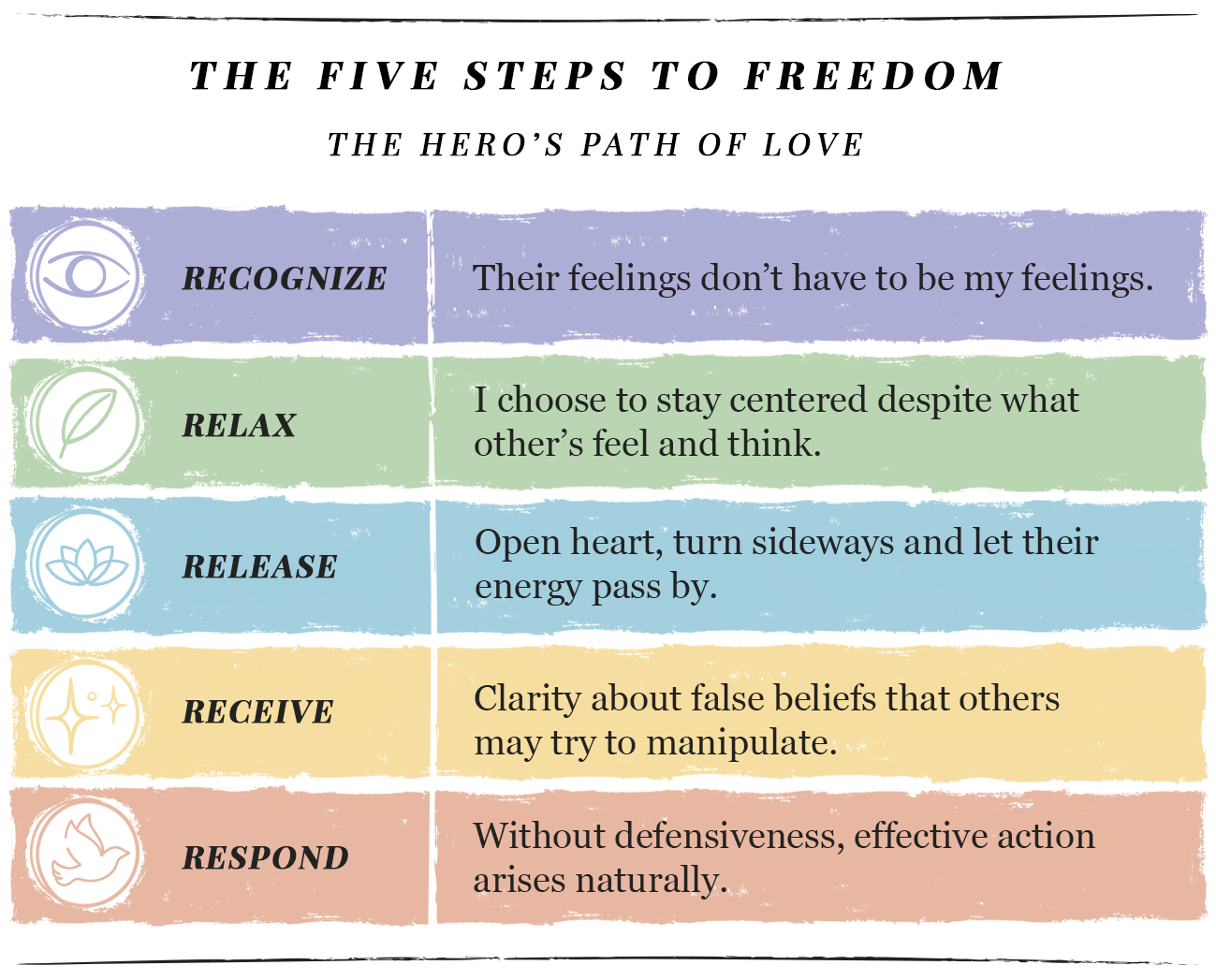
Here is what the practice looks like for the empath apparatus operating at its higher mode. Five movements that train the channel rather than defending it.
Empath wiring, especially when paired with childhood adaptations to chaotic environments, can produce sustained nervous-system dysregulation that benefits from skilled support. The Five Steps and the alchemist practice work alongside real human and clinical care. They do not replace it.
988 Suicide & Crisis Lifeline — call or text 988 — free, confidential, 24/7
Crisis Text Line — text HOME to 741741
If your empath wiring developed in a household with sustained dysfunction, narcissistic dynamics, or unprocessed trauma, please consider working with a trauma-aware therapist or somatic practitioner. The lower-octave empath patterns — chronic absorption, people-pleasing, depletion, hypervigilance — often have early roots that benefit from being honored and worked with directly. Approaches like Internal Family Systems, Somatic Experiencing, EMDR, and trauma-informed cognitive therapy can be particularly helpful for empaths working to find the middle and higher octaves.
And if much of your empath energy has been spent inside a relationship with someone whose patterns have been controlling, gaslighting, or systematically depleting you, the Narcissistic Abuse path is the companion to this one. Empaths and narcissists often find each other for reasons rooted in both directions of the dynamic, and naming that pattern is part of the work.
Your sensitivity was never the problem.
You were told it was. Most of your life, by people who loved you and people who did not, by teachers and partners and parents and friends, by an entire culture that did not know what to do with the kind of nervous system you arrived in. You learned to apologize for it. You learned to manage around it. You learned to dampen it with whatever was available — substance, busyness, isolation, performance — and you learned to call yourself too much when nothing else would explain why other people seemed to need so much less protection from the world than you did.
The world was wrong about you. The apparatus you arrived in is a piece of soul-level technology that the contemporary mainstream has not yet learned to recognize. It was given to you for a particular reason — not to make your childhood harder, though it sometimes did, and not to make your adulthood lonelier, though it sometimes has. It was given to you because there is work to be done in this world that requires souls who can feel what other souls are carrying, and there are not enough of you, and there is not yet a wide enough understanding of what your gift was actually for.
Sir Ego is not your enemy in this. He has been managing the apparatus with the only tools he had — shutdown, absorption, people-pleasing — and he has loved you the entire time. He just did not know yet that there was a higher octave the gift was built for. As you give him the new instructions, he will learn them. Not all at once. In moments. In conversations. In rooms where you find yourself unexpectedly able to stay open while a storm moves through. He will learn what you have just learned: the work is not to defend the channel. The Wise One in you lets the channel do what it was always for.
What it is for is this. Stuck energy moves out. Divine light moves in. The empath becomes a vent for what cannot leave any other way, and a doorway for what cannot enter any other way, and the people in your life will receive what you are channeling without having any idea what is happening, and that is exactly how it is meant to work. You will be tired afterwards. You will be tired in a clean way, not a poisoned way. The tiredness is the proof that the work was real and complete.
The Wise One in you has known about the higher octave the entire time. She has been patient. She has been waiting for Sir Ego to be ready to receive the new orders. The pages you read and the practice you walk and the years of being told you were too sensitive — all of it was getting you ready for this. You are not late. You are right on time.
Walk gently. Keep the heart open. Let the storms pass through. Let the light come back.
Not perfectly. Heroically. That has always been the only way home.
A daily practice tool that holds the Five Steps for you — for the moments when the storm walks in and the heart needs to stay open and you need a structure to walk it. Free. Quiet. Always available.
Visit the Trigger DecoderIf what you need is the practice in your own hands — the Five Steps in full, calibrated to the empath who is ready to find the higher octave — Love Heroically is for you.
If what you need is the bigger frame — the cosmology that explains why so many empaths arrived together at this hinge point in history, what the apparatus was given to you for, and what the Age of Love is asking of those who can feel the field — What Happened to US? is for you.
Neither one requires the other. Both lead home.
The Five Steps in full. The practice manual for the Tuesday afternoon when the storm walks in and the heart needs to stay open. Plain language. Real ground. The integration that walks the empath from absorbing to transmuting. Heroically, not perfectly.
Learn more →The cosmology underneath the practice. Why so many empaths arrived together in this generation. What the apparatus is for at the level of the larger arc. What the Age of Love is asking of the souls who can feel what the field is carrying.
Learn more →These questions arrive often from readers who have been called sensitive, empathic, or highly attuned. Each answer comes from the framework's voice — recognizing what your soul came in to do and offering practical infrastructure for sustaining the work. If any of these open a doorway, the path goes deeper.
You walk into the room and within thirty seconds you have read the entire emotional weather. The fight that just ended before you arrived. The tension between two people across the room. The grief one person is barely holding inside her smile. You came home from the family dinner carrying everyone's everything, and the next day you spent half-recovered, and the day after that you finally returned to baseline just in time for the next gathering. The exhaustion is real. Sir Ego has been treating the gift as a malfunction, and the question of whether it is a curse has been growing louder.
The exhaustion is information about which octave the apparatus has been operating in. The empath gift has at least three octaves, and almost everyone is taught only the first one — the absorption layer, where other people's emotions land in your body and stay there until you can painfully process them out. This is the level the standard empath advice addresses, with shielding visualizations and energy boundaries and salt baths and white light. These tools are real and sometimes useful. They also leave the apparatus operating in the same octave that has been exhausting you, just managed slightly better.
The middle octave is where the empath learns to keep the heart open while the energy moves past rather than into the body. The apparatus stays connected to the room, but the absorption stops happening in the same way. This is real, and it is teachable, and it is most of what advanced empath practice eventually arrives at.
The higher octave is where the apparatus does what it was always for. From this seat, the energy moves through your channel into the larger field, where it disperses, while divine light flows back through the same channel toward the people you are with. You are not absorbing. You are not deflecting. You are venting. The apparatus becomes a two-way conduit, and the work that has been so exhausting at the lower octave becomes lighter at the higher one — sometimes profoundly so.
The Wise One in you has been operating at the higher octave the whole time, in the moments Sir Ego has been still enough to allow it. She has been with you at every family dinner, every crowded room, every encounter that ended with you depleted, holding the apparatus at its native frequency, knowing what it has always been for. The exhaustion is the gift being run at the wrong octave by Sir Ego's well-meaning management. From her seat, the apparatus operates differently.
✦ What if the part of you who has been holding the apparatus at its native frequency has been waiting for you to feel her run it?
You have read the empath books. You have practiced the shielding. You have visualized the white light, set the energy boundaries, cut the cords, taken the salt baths. Some of it has helped some of the time. None of it has resolved the underlying issue, which is that you keep finding yourself with other people's emotions inside your body, hours or days after the encounter, and the standard tools have been managing the symptom rather than dismantling the structure.
Here is the structural truth that the standard advice tends to skip past. The work is not to stop absorbing. The Wise One in you knows what the empath apparatus is actually for — something other than absorbing or shielding. The contemporary empath conversation has been operating on the assumption that the apparatus's job is to register other people's emotions, and the only question is whether to absorb them or block them. Both options miss the architecture entirely.
The apparatus is a channel. It was built to let energy move through it, not into it. The absorption that has been exhausting you is what happens when the channel has been gripped closed at the far end — the energy comes in, but with no exit, it has nowhere to go but to settle in your body. The shielding has been a different way of gripping the channel closed, this time at the near end, refusing the energy entry. Both options keep the apparatus in defensive posture, and both miss what the apparatus is actually for.
When the channel is open at both ends, the energy moves through. The other person's stuck material flows through your channel into the larger field, where it disperses. Divine light and love flow back through the same channel toward the person you are with. You are not absorbing it. You are not blocking it. You are letting it move. The aftermath of an encounter run from this seat is tiredness, often, but a clean tiredness — the kind that arrives after real work has been completed. Different signature than the depleted exhaustion of the absorption pattern.
The Wise One in you knows how to keep the channel open. She has been doing this, in the moments when Sir Ego stopped trying to manage the absorption. From her seat, the question of how to stop absorbing has a different answer than Sir Ego has been generating. The answer is to stop trying to control the channel, and let it do what it was designed to do. She has been waiting to show you.
✦ What if the part of you who knows how to keep the channel open has been here the whole time, waiting for the management to stop long enough for her to operate?
You have heard it your whole life. From parents who could not understand why their offhand comment landed so hard. From teachers who told you to toughen up. From friends who got tired of accommodating your reactions. From partners who said you were too much. The phrase "too sensitive" has been the verdict on you, delivered by people you trusted, and you have absorbed it as accurate even though something in you has always quietly resisted it.
The people telling you this are operating from a different nervous system than yours. Their sense of what counts as appropriate sensitivity is calibrated to their own range, which is shorter than yours. They have not been wrong about the calibration of their own nervous systems. They have been wrong about treating their range as the correct standard against which yours is being measured.
Sensitivity is a property of the nervous system, structurally, the way height is a property of the body. There is a normal distribution, and you happen to fall on the more-sensitive end of it. The empath apparatus is a particular configuration of this sensitivity that registers other people's emotional states with unusual clarity. Calling this configuration "too much" makes the same kind of sense as calling someone's height "too tall." It is information about whose ruler is being used to measure, not about what is being measured.
There is also a real teaching underneath the dismissal. The world has been organized around the average nervous system, which means highly sensitive people often develop more conscious management skills than less sensitive people need. This is the cost of operating an unusually sensitive apparatus in a world that has been designed for the average. The Wise One in you knows what the apparatus is for and how it operates at its higher octaves. People whose nervous systems operate at different sensitivities have been working from a different design altogether.
The Wise One in you has never agreed with the verdict. She has been the part of you who has known the apparatus was real, valid, and given to you for reasons. She has been steady through every dismissal, holding what she has known about your sensitivity at a layer the dismissals have not been able to reach. The recognition you have been resisting their verdict from is hers.
✦ What if the part of you who has been quietly knowing your sensitivity is the gift it is has been right the whole time?
The pattern is structural, and it has been described in detail elsewhere on this site. If you are walking this terrain in active form, please read the Narcissistic Abuse path; the questions you are carrying are addressed there with the depth they deserve. What follows is the empath-specific contribution to that broader picture.
Empaths and narcissists find each other for reasons rooted in both directions. The narcissist arrives carrying an inner emptiness he cannot fill himself, often described as ego operating with very few of the divine aspects flowing — calm, peace, power, love, joy, wisdom, light, expression are blocked from coming through. The interior life that results is closer to a hungry vacuum. The empath arrives with an overflowing capacity for emotional attunement and a long-practiced skill at reading and managing other people's interior weather. The early days feel like rescue for both parties. The narcissist feels full for the first time. The empath feels purposeful, useful, finally in a relationship where her gifts matter. The unspoken contract gets sealed before either party knows it has been written: the empath manages the narcissist's emotions, and the narcissist gets to punish her when she fails at the impossible job.
The empath's contribution to the dynamic, which is what this answer can specifically address, is the unconscious agreement to take the job in the first place. The agreement was sealed before conscious choice was possible, often based on a seed planted long before this relationship existed — usually in childhood, with a figure whose love felt conditional, withheld, or impossible to earn. The seed taught the soul that love is something to be won through sufficient effort, and the narcissist's emotional unavailability fits the seed's specifications precisely. The empath's lower-octave training to manage other people's emotions met the narcissist's need to have his emotions managed, and the structure formed in conditions neither party fully understood.
The way out is not better management. The way out is recognizing that the job was never actually yours, that the empath apparatus was given to you for a different purpose entirely, and that resigning from the position of manager-of-his-emotions is the doorway out of the dynamic. Resigning does not require you to leave the relationship in any particular timeline; it requires you to stop accepting the contract at the energetic layer. Once the contract begins to be released, the relationship reorganizes — sometimes through the partner adjusting, more often through the partner intensifying, sometimes through the eventual recognition that the structure itself is the problem and the relationship cannot continue.
Please use the practical tools the narcissistic abuse terrain offers — the Domestic Violence Hotline if there is physical danger, a therapist who specializes in this work, a support community of others who have walked this path. The Wise One in you has known the contract was a contract from the beginning, and she has been waiting for the conditions to be right for it to be seen and slowly released.
✦ What if the part of you who has known the agreement was a structure rather than a fact has been waiting for you to be ready to release it at the energetic layer?
The room gets too loud — emotionally loud, not necessarily literally loud — and something in you flips a switch. You go quiet inside. You feel yourself receding from the edges of your body. The room continues, and you continue with it on the surface, but the part of you that registers what is happening has stepped back into a chamber where the volume is lower. Afterward you feel hollowed out, distant from yourself, sometimes unable to fully access your own emotional state for hours or days.
The shutdown is the empath system's protective mechanism, kicking in when the apparatus has been overwhelmed beyond what it can hold. It is the gift's nervous system protecting itself when the running of the gift has become unsustainable. Most empaths who have lived for years in environments of sustained emotional intensity develop some version of this pattern. It is structural, and it has been keeping you functional in conditions that would otherwise have produced full breakdown.
The shutdown is also a sign that the apparatus has been operating at the lower octave for a long time, with the absorption pattern accumulating beyond the body's capacity to clear. The shutdown is the body saying: I cannot hold any more. The empath who is shutting down has been doing too much energetic work at the wrong layer for too long. The question is not whether to keep shutting down or to stop; the question is whether the apparatus can begin to operate at a different octave so the shutdown stops being needed in the first place.
The middle and higher octaves of the empath gift produce a fundamentally different signature. From these seats, the apparatus does not accumulate the way it has been accumulating, and the system does not require shutdown as a protective response, because the load is no longer overwhelming. This is slow work. The shutdown will not stop happening overnight; it has been protecting you, and it will keep protecting you until something else is reliably available. As the higher-octave operation builds in small flashes, the shutdown becomes less frequent, less severe, less needed.
If the shutdown is severe, persistent, or producing significant dissociation, please work with a trauma-informed therapist who understands somatic regulation. The framework walks alongside that support; it does not replace it. The Wise One in you has been with the shutdowns, knowing they were doing necessary work, holding the part of you who has needed protection until something else became available.
✦ What if the part of you who has been protecting the system has been holding it in love through every shutdown, waiting for a different operation to become possible?
You knew the friend was going to call before the phone rang. You walked into the building and felt the wrongness three minutes before someone explained what had happened. You looked at a stranger across the room and registered information about her that turned out to be accurate when you later learned more. Sir Ego has been uncomfortable with these moments, because they do not fit the framework he has been operating from, and he has been alternating between dismissing them and being unsettled by them.
The framework's posture is that we are all, at some level, picking up information beyond the five physical senses. Empaths happen to be more attuned to this layer than most, and the attunement is one of the apparatus's native capacities. Calling it psychic is one valid frame. Calling it intuition is another. Calling it the natural sensitivity of an open nervous system is another. Each frame captures something true, and none requires belief in anything beyond what you can directly verify in your own experience.
Here is the structural piece that matters more than the labeling. This sensing is also how the Wise One in you communicates. The information that arrives before the phone rings, the recognition that lands before someone explains, the knowing that has no traceable source — these are channels through which the Wise One has been sending you signals continuously. Sir Ego has been receiving them and dismissing them because they did not fit his ordinary information-gathering protocols. The Wise One has been speaking the whole time. The empath apparatus has been her primary delivery mechanism.
Learning to recognize this is one of the most useful capacities the empath terrain offers. The signals are reliable when the apparatus is operating cleanly — meaning when Sir Ego is not adding interpretation, anxiety, or projection on top of the original signal. Practicing the difference between the clean signal and the layered interpretation is what allows the empath to develop genuine reliability with this faculty. The Wise One sends the signal. Sir Ego often turns it into a story. Discernment is recognizing which is which.
The Wise One in you has been the source of every accurate sensing you have ever had. She has been transmitting through the apparatus you have been calling psychic or intuitive or sensitive, regardless of which name you have been using. From her seat, the sensing is one of the most natural things you do — unforced, accurate, and available the moment Sir Ego sets his interpretive layer down.
✦ What if the part of you who has been doing the sensing has been the Wise One the whole time, speaking through the apparatus you have been wondering about?
The empath identity has been a way of locating yourself — the sensitive one, the one who feels for others, the one whose nervous system is attuned to suffering. And then there are the moments when you are cruel. The moments of cold detachment when you watch someone struggle and feel nothing. The flashes of rage that surprise you with their intensity. These moments seem to contradict the identity, and Sir Ego has been confused about whether they mean the empath identity has been fraudulent.
Empaths are humans, not saints. The same nervous system that registers other people's pain registers your own pain too, and the pain has its own legitimate expressions, including rage. The cold detachment is often the apparatus's protective response when it has been overwhelmed beyond what it can hold; the cruelty is sometimes the suppressed rage finding an outlet that was previously unavailable. None of these moments invalidate the empath apparatus. They are information about the apparatus operating under stress, in a body that contains the full range of human emotional capacity, including the difficult ones.
The contemporary empath conversation has tended to romanticize empaths as constitutionally good — soft, kind, attuned, gentle. The romanticizing has set up empath-identifying readers to be confused by their own non-romantic moments, and to wonder whether the moments mean their empath identity has been performative. The framework holds a more honest picture. Empaths feel everything, including the things that are not gentle. The capacity to feel deeply does not exempt the empath from the full human range.
There is also a structural piece worth naming. Empaths who have spent years suppressing their own emotions in service of managing other people's emotions often develop reservoirs of unexpressed feeling — including rage at having been required to do that work for years without recognition, anger at having been treated as the household's emotional regulator, frustration at having absorbed material that was not theirs. The reservoirs surface in unexpected moments, sometimes as cruelty, sometimes as cold detachment, sometimes as flashes of rage that feel disproportionate to the immediate trigger. The empath apparatus has been carrying years of suppressed material that has every right to be felt.
The Wise One in you has been holding the full range — the attunement and the rage, the kindness and the cruelty, the tenderness and the cold. She is not embarrassed by any of it. She has been present through every moment, including the ones Sir Ego has been ashamed of, knowing the human range is the human range and that the empath apparatus does not require its operator to be saintly to be authentic.
✦ What if the part of you who has been holding the full range has known all along that the apparatus is real and the human is human, with no contradiction between them?
You grew up in a family where you were the one who registered everyone's emotional state. You were the one who knew, at six years old, that something was wrong before the adults said anything. You were the one who came home from school and immediately read the room before deciding whether to mention your day. You were the one whose internal weather was constantly being calibrated to the external weather of the household. And the family has not understood this about you. To them, you have been the dramatic one, the sensitive one, the difficult one, the one who feels too much.
Family systems often have a designated empath, and the designation usually happens early. The empath child becomes the household's emotional regulator without consent, registering the family's collective state and adjusting herself to maintain whatever stability is possible. The role is one the system selected her for, based on her nervous system's particular sensitivity, and she absorbed it before she had the language to make her own choice about it. By the time she was old enough to notice, she was already deeply embedded in the role.
The family's lack of recognition is information about the family's structure, separate from any verdict on you. The non-empath family members are operating from nervous systems that have not been registering what yours has been registering. They have not been wrong; they have been working with the equipment they have. Their characterization of you as too sensitive or dramatic is information about their range. It does not mean what they have said it means.
The work, when the curriculum is ready, is to validate your own experience without requiring their cooperation. You can love them and not need them to understand. Both at once. Some empaths in non-empath families develop chosen-family relationships with other empaths who get them at a level the original family cannot, and these relationships often become the source of the recognition the original family was structurally unable to provide. None of this requires you to abandon the original family; it allows you to expand the field of recognition beyond it.
The Wise One in you has been validating your experience the whole time. She has been holding what she has held, with no concern for whether the family system was capable of recognizing what she has been recognizing. Her witnessing has been steady regardless of who has shown up to participate. The pull to be seen by your family is real and worth honoring; the pull does not require their cooperation to be answered, because she has already been answering it from inside you the whole way.
✦ What if the part of you who has been witnessing your experience has been doing so from a layer the family system was structurally unable to reach?
You crave solitude. After a day in the world, the silence of your own space is the only thing that lets you reset. You have built a life that allows for sustained periods of being alone, and the alone time has been one of your essential nutrients. And underneath the alone time, sometimes, runs a loneliness that surprises you, because you thought solitude was supposed to feel different than this.
The empath nervous system requires more solitude than non-empath nervous systems to process what it has absorbed. This is structural rather than a preference. The apparatus has been registering other people's emotional material throughout the day, and the body needs uninterrupted time to clear what has been accumulated. The craving for solitude is the body's accurate request for what it actually needs.
And the loneliness is also accurate, in its own way. The empath who has spent decades in absorption mode is often disconnected from her own interior life, because the apparatus has been so trained to scan outward that her own feelings have been hard to access. When the absorption phase is winding down — when the alone time has done its clearing work — what surfaces underneath is often the recognition that she has been alone with her own experience for a long time without quite recognizing what that meant. The loneliness is information that the absorption is finishing and that connection-from-recovery is becoming possible, often in a different form than the connection that was draining her before.
The empath who has been operating at the lower octave needs solitude to recover from connection. The empath who has begun operating at the higher octaves often finds that connection itself becomes less depleting, because the apparatus is no longer absorbing in the way it had been. The loneliness softens, then, not because she has more company, but because the company she does have is no longer exhausting her, and the alone time becomes restoration rather than survival.
The Wise One in you knows the difference between healthy solitude and the loneliness that comes from disconnection. She has been with you in both, holding what each phase has been about. From her seat, the alone time is genuinely nourishing, and the loneliness is information rather than verdict — information that some part of you has been waiting to be felt that the absorption phase has been crowding out.
✦ What if the part of you who knows the difference between solitude and loneliness has been holding both with steady recognition the whole time?
You have looked at your relationship history and seen the pattern. The intense connections that turned out to be entanglements. The rescues. The relationships where you carried the emotional weight for both parties. The endings that left you depleted in ways your partners did not seem to leave themselves. And you have started to wonder whether the empath apparatus is structurally incompatible with partnership, or whether you have been doing something wrong, or whether the pattern is doomed to repeat.
Empath relationships are possible and can be unusually deep. The previous difficult relationships were the curriculum that made the work possible. They were not failure; they were the karmariculum's way of making the empath apparatus's lower-octave default impossible to maintain. Each difficult relationship surfaced more of what was happening structurally, and the recognition forming now is the curriculum's gift.
Healthy empath relationships have a particular signature. Both partners are responsible for their own emotional weather, with the empath's apparatus serving as occasional channel rather than constant manager. The partner is not relying on the empath to regulate his interior life; he is doing his own work, and the empath is contributing her gift without taking on his work. Energetically, the relationship is symmetrical — different gifts, different responsibilities, both partners doing their own integration. From the higher octaves of the apparatus, the empath in this kind of relationship is enlivened by it rather than depleted.
The previous relationships were probably not symmetrical in this way. Either the partner was a narcissist or addict whose pattern required management; or he was a wounded soul who unconsciously offered the empath the management role; or he was a generally healthy person who happened to lack the language to do his own emotional work, and the empath stepped in by default. Each of these configurations produces depletion, regardless of the partner's intent. The next relationship — when it arrives, when the work has matured enough that the old pattern is recognizable from the inside — has a chance to be configured differently.
The work, in the meantime, is to develop your own discernment about what symmetrical actually feels like. The Wise One in you knows the difference between a relationship where you are working and a relationship where the energy moves in both directions. Sir Ego has been trained to mistake the working for love, because the working felt familiar from childhood and the love that flows in both directions has felt unfamiliar. Recognizing the difference is the doorway. From her seat, the next relationship can be configured around something the previous ones could not have offered.
✦ What if the part of you who knows what symmetry feels like has been waiting for you to recognize when love and working are different things?
You went into therapy or social work or nursing or teaching or pastoral care or any of the helping professions, because the pull was real. You wanted to do work that mattered. You wanted to use your sensitivity for something that contributed to the world. And within a few years, sometimes within a few months, you were depleted. The clients drained you. The institutional pressures drained you. The volume of suffering drained you. You started fantasizing about leaving, and then leaving felt like betrayal of the calling, and the betrayal-feeling drained you further. Something is wrong, and the wrongness has been generalized to helping, and you have started to wonder whether your gift is incompatible with using it professionally.
Nothing is wrong with the helping work itself. The wrongness is information about which seat the work has been getting done from. Helping professions carried out from Sir Ego's seat — managing other people's emotions, trying to fix their suffering, taking on their material into your own body, performing helpfulness — produce burnout regardless of profession or technique or self-care regimen. The apparatus was never designed to contain other people's pain. The lower-octave empath in helping work is doing what the apparatus is structurally not equipped to do, and the depletion is the body's accurate report on the impossibility of the task.
The same number of hours in the same profession, run from the Wise One's seat, produces a different signature. The energy moves through the apparatus rather than into it. The love flows from a source that has its own replenishment. The clients receive what they need at a layer the lower-octave version could not have delivered. And you, the practitioner, are enlivened by the work rather than exhausted by it. This is the difference between two fundamentally different operations performed by the same apparatus.
Look at where in your life you have been on fire — work that has lit you up, projects that have produced more energy than they consumed, hours that have flown rather than dragged. Whatever the activity was, the Wise One was operating it. Now look at the helping work that has been depleting you. Whatever the activity was, Sir Ego was operating it, trying to do what he believed helping required, generating exhaustion through the impossibility of the task he set himself. The variable is not the work. The variable is the seat.
The work is to discover how to do helping work from her seat. This shift takes time; it requires the deeper inner work the framework has been describing throughout, slowly, over many returns. Many empaths in helping professions discover that as they make this shift, the work itself transforms — different clients arrive, different conversations become possible, different outcomes emerge. The profession is fine. The way of practicing it has been the issue, and the way of practicing it is something the karmariculum is in the process of teaching you.
✦ What if the part of you who has been waiting to do this work has been holding the version of helping that lights you up rather than burning you out?
The two often look similar from outside. The hypervigilance that anxiety produces — constant scanning, threat-detection, attention to other people's moods — is structurally similar to the scanning that empath sensitivity produces. The exhaustion at the end of a social day looks similar from either source. The need for solitude after time in the world looks similar. And you have been wondering whether what you have been calling empath sensitivity has actually been generalized anxiety wearing a more flattering name.
The two often co-occur, and the co-occurrence is part of why the distinction is hard. Many empaths are also anxious, and many anxious people develop empathic tendencies as part of their hypervigilance. The framework holds both as real and offers a structural distinction rather than requiring you to choose.
The clean signal of empath sensing arrives without fear underneath it. You walk into the room and the information about who is upset, what is tense, what is being unspoken, lands as information. There is a quality of clarity to it. The Wise One in you has been delivering these signals continuously. They feel like knowing rather than worrying. Anxiety, by contrast, generates information that has fear underneath it. The scanning is driven by the need to detect threats. The information arrives mixed with activation, with what-if scenarios, with the felt sense that something needs to be managed before it becomes catastrophic. The signal-plus-fear is anxiety's signature, and it is structurally different from empath sensing's signal-as-information.
In practice, the two often arrive together. You may receive empath information about a tense room, AND your nervous system may then generate anxiety on top of the information. The empath sensing is the clean part; the anxiety is the layer Sir Ego adds on top. Distinguishing the two takes practice. The work is to feel for the signal underneath the activation — the knowing component, separate from the worrying component. They are different operations, and once you can feel the difference reliably, you can honor the empath signal without letting the anxiety layer dictate the response.
The Wise One in you knows the difference. She is the source of the clean signal, the one without the fear underneath. The anxiety is Sir Ego doing his best to convert her information into a form he can act on, generating the activation as a side effect. From her seat, the empath signal is steady and useful, while the anxiety layer becomes something that can be noticed and let pass without organizing the response.
✦ What if the part of you who is the source of the clean signal has been steady through every anxious moment, with the signal intact underneath the activation?
You have been so trained to scan for external sources of feeling that you have started to wonder whether you have any feelings of your own. When sadness arrives, your first move is to figure out whose sadness it is. When anxiety arrives, you scan for whose nervous system you must have absorbed it from. When joy arrives, the question is whether it belongs to someone in your life whose mood is currently elevated. And sometimes you are alone, with no obvious external source, and the feeling is still there, and you do not know what to do with it.
Yes, much of what you feel is yours. The empath apparatus has been so well-trained to attend outward that her own interior life often gets less attention than the interior lives of the people around her. The apparatus has not been wrong about the external sources; she has been right about a great deal of what she has registered as belonging to others. And alongside the absorbed material, your own feelings have been continuing the whole time, often unmet, sometimes unrecognized, frequently mistaken for someone else's because the habit of attribution has been pointed in the wrong direction.
The work, gently and over time, is to get to know your own interior life as your own. The feelings that arrive when you are alone are usually a reliable starting point — there is no external source available to absorb from, so the feelings have a higher probability of being your direct experience. Sit with them without immediately searching for whose they might be. Let them be yours. The apparatus has been performing the scanning function for so long that the muscle of this is mine may have atrophied; rebuilding it takes practice.
There is also a deeper recognition that often surfaces here. Many empaths absorbed early messages that their own feelings were less important than the feelings of the people around them — that being attentive to others was the way to be loved, and that having her own emotional reality might be inconvenient or punishable. The seed planted early has been running in the background for decades. The feelings she has been treating as everyone else's have sometimes been her own all along, displaced into someone else's column because her own column was not safe to fill.
The Wise One in you has known the feelings were yours the whole time. She has been holding them, even when Sir Ego has been busy attributing them elsewhere. She has not required you to identify the right column for them; she has simply held them, knowing they belong to you. From her seat, your interior life is a real thing, populated by your own feelings, and the recognition of which is which is one of the gifts the work eventually delivers.
✦ What if the part of you who has been holding your feelings as yours has known the whole time, even when Sir Ego was busy giving them to someone else?
You have been reading the trauma research. You have been recognizing yourself in descriptions of hypervigilance, in the patterns of children who grew up scanning their environments for danger, in the language of complex post-traumatic stress. And you have been wondering whether the empath identity you have been carrying is actually a more flattering way of describing what is structurally a trauma response. Whether your sensitivity is real, or whether it has been a coping mechanism developed in childhood that you have been mistaking for a gift.
Both can be true at once, and the framework holds both honestly without requiring you to choose. Childhood trauma can produce hypervigilance that looks structurally similar to empath sensing. The patterns described in CPTSD research are real and accurate to many people who also identify as empaths. AND the empath apparatus is also real, as a configuration of nervous system that some souls arrive with regardless of childhood conditions. Souls with empathic configurations who experienced trauma in childhood often develop hypervigilant patterns on top of their natural sensitivity, producing a hybrid signature that is partly trauma response and partly innate gift.
Trying to determine which percentage of your sensitivity is empath-gift and which is trauma-response is usually unproductive, because the two have been operating in the same nervous system for so long that they cannot be cleanly separated by self-examination. What is more useful is recognizing that the apparatus, whatever its mix of origins, is now what it is, and the work of operating it at its higher octaves is the same work regardless of how it was formed. The trauma needs honoring through whatever therapeutic work serves it. The empath gift needs operating at the higher octaves through the work the framework describes. Both can happen at the same time.
There is also a structural recognition that often surfaces here. Souls who came in with empath configurations often arrived in situations where the configuration would be trained — sometimes harmfully, often through difficult childhoods — into the lower-octave default. The karmariculum often arranges the conditions that produce exactly the configuration the soul came in to walk. This is a structural observation about how the empath apparatus and the trauma-trained patterns are often woven together at the soul level, with full honoring that the harm was real, and untangling them is part of the curriculum's work.
The Wise One in you has been holding both the gift and the trauma the whole time. She has not required you to choose between them, because she has never been confused that they are separate things. She has been with you through every hypervigilant childhood moment and through every adult moment of recognition, knowing that the apparatus is real and the trauma was real and the work involves honoring both.
✦ What if the part of you who has been holding both the gift and the trauma has been waiting for you to recognize they have been woven together the whole time, with no need to choose between them?
Kindred Lights offers spiritual perspective and contemplative practice. It is not a substitute for psychotherapy, somatic work with a skilled practitioner, or any form of clinical mental health care. If your empath patterns are connected to unprocessed trauma, sustained dysregulation, or a relationship that is currently depleting you, please consult appropriate professionals. The teachings here are meant to walk alongside that support — not to replace it.